S1-05: How does coding fit in the science classroom? A conversation with Aryanna Trejo of Code.org
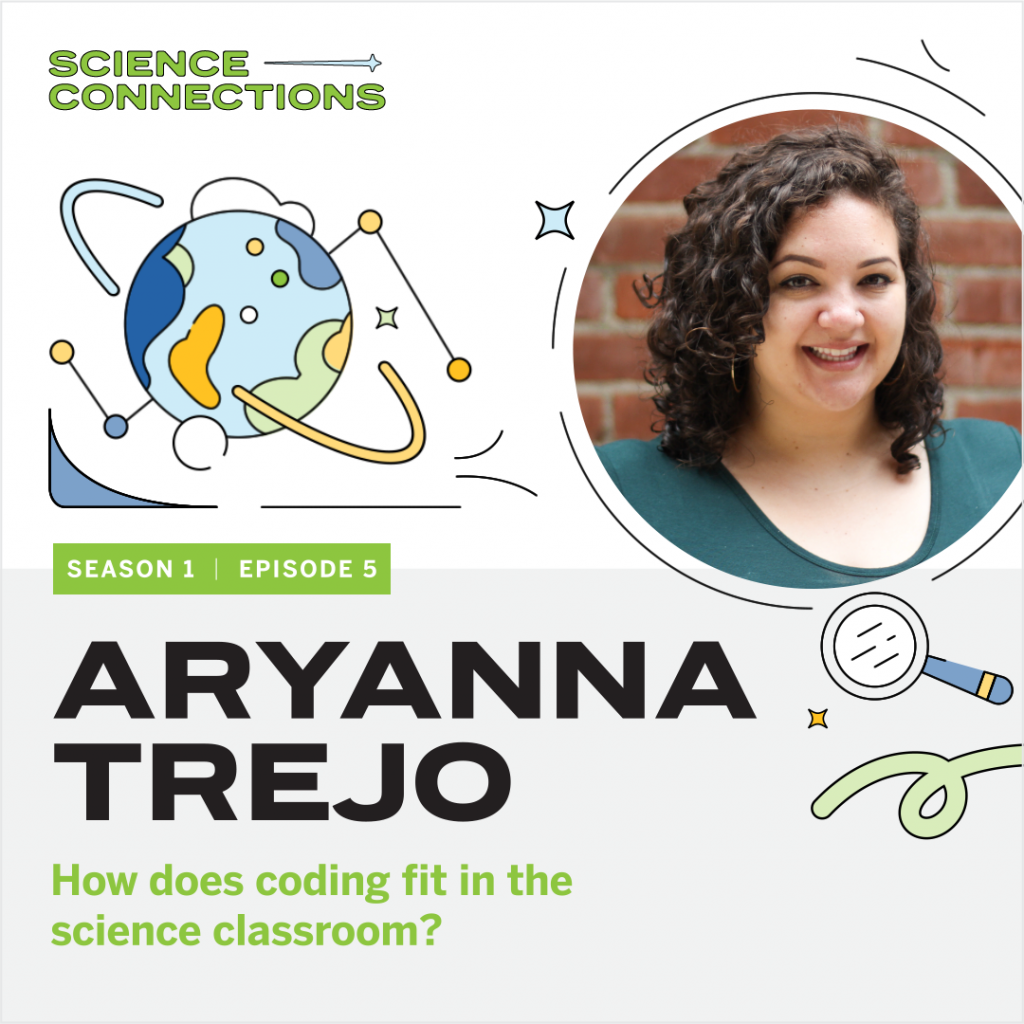
Podcast cover titled "Science Connections" featuring Aryanna Trejo, Season 1, Episode 5. It includes abstract illustrations of a globe and telescope, discussing coding in the science classroom.

In this episode, Eric sits down with Aryanna Trejo, a professional learning specialist of Code.org. Aryanna shares her journey from working as an elementary teacher in New York City and Los Angeles to teaching other educators at Code.org. Eric and Aryanna chat about computer literacy within the science classroom, problem-solving skills, and ways to model productive struggle for students. Aryanna also shares ways to teach coding and computer literacy in schools, no matter the classroom’s technology level. Explore more from Science Connections by visiting our main page.

Download Transcript

Aryanna Trejo (00:00):

I would hear teachers saying things like, “Well, I just can’t do coding; this is too hard for me; the time has passed.” And I would ask them, “Would you say that to your student about math or English?” And they would always sheepishly go, “No.” And I’d say, “Well, be as kind to yourself as you would be to your student.”

Eric Cross (00:19):

Welcome to Science Connections. I’m your host, Eric Cross. My guest today is Aryanna Trejo. Aryanna is a member of the professional learning team at Code.org. Before joining Code.org, Aryanna led computer science professional development for elementary school teachers, and served as an instructional coach for new educators. She also taught fourth and fifth grade in both New York City and in Los Angeles. In this episode, we discuss Aryanna’s journey to Code.org, where she helps educators connect coding to real life, how to use a rubber duck to solve problems, and how coding and computer science principles can be taught to students in areas without access to the internet…or even a computer. I hope you enjoy my conversation with Aryanna Trejo. So I was born and raised here, and I saw that you went to UC San Diego.

Aryanna Trejo (01:11):

I did, I did. I actually just put a deposit down on an apartment in University Heights, ’cause I’m moving back.

Eric Cross (01:16):

You’re coming back?

Aryanna Trejo (01:17):

I’m coming back. Yeah.

Eric Cross (01:19):

So if you need a classroom to visit….

Aryanna Trejo (01:21):

I would love to do more classroom observations!

Eric Cross (01:24):

Are we doing this? Let’s do—we’re making this happen.

Aryanna Trejo (01:26):

We are. Yeah. So I’ll be there. I’m moving there in April. I actually grew up in Orange County too, so I’m like a very diehard SoCal person.

Eric Cross (01:35):

So I feel like I know the answer to, hopefully—Tupac or Biggie? ‘Cause you’re on the East Coast, and you’re on the West Coast.

Aryanna Trejo (01:40):

Yeah. I like Tupac, but I have more Biggie songs committed to memory. Which is not a lot. I have “Juicy” and “Hypnotized” memorized.

Eric Cross (01:53):

All right. So you’re just memorizing, and you have the Biggie songs memorized, but not the Tupac ones.

Aryanna Trejo (01:58):

No, but I do love Tupac songs. You know, it’s like, Biggie has the flow, but Tupac has the lyrics. Nobody’s—they both have something really amazing about them.

Eric Cross (02:06):

You know, I can respect that you broke it down into both of their strengths.

Aryanna Trejo (02:11):

Thanks for buttering me up before this interview. And not….

Eric Cross (02:15):

<laugh> Oh, we already started.

Aryanna Trejo (02:16):

Huh? We already started?

Eric Cross (02:17):

We’re already started. Yeah. We’re already into this.

Aryanna Trejo (02:19):

We’re into it.

Eric Cross (02:21):

You were in the classroom, fourth and fifth grade, and you were doing TFA.

Aryanna Trejo (02:26):

I did. I did Teach For America. I was 2012, New York City Corps. Right after graduation. ‘Cause I graduated UC San Diego in 2012. So graduation was on June 17th, and I touched down at JFK on June 19th.

Eric Cross (02:40):

Even though I wasn’t in TFA, I know a lot of the fellows that are in it. And there’s just some phenomenal teachers in there. How long were you doing elementary school when you were teaching?

Aryanna Trejo (02:49):

Yeah, I taught for—well, I did, three years of teaching fourth grade. Then there happened to be an instructional coach opening in my fourth year. I took that, did some instructional coaching within the same network, and then I moved back to LA and I taught fifth grade for a year.

Eric Cross (03:11):

  1. And what was it like now? Did you go to Code.org right after the classroom?

Aryanna Trejo (03:17):

No, I didn’t. No. I transitioned after teaching fifth grade for a year in downtown Los Angeles, in the Pico-Union neighborhood. I ended up getting this email out of the blue from someone who had actually found me through the Teach for America job site. ‘Cause I was hitting the pavement; I was really looking to transition out of the classroom. And she invited me to interview with this company called 9 Dots. And they taught computer science to kids K–6 throughout Los Angeles and Compton. And I was like, “Sure, no problem. Let’s do it.” So I interviewed, I got the job, and yeah, that’s how I transitioned to 9 Dots. And then after almost four years there, I transitioned to Code.org, with the same person. Actually, she moved over to Code.org first, and then she helped me get this job.

Eric Cross (04:07):

Oh, that’s happened a lot—like, that relationship kinda carries over.

Aryanna Trejo (04:11):

Yeah. We’re meant to be coworkers.

Eric Cross (04:13):

Yeah. Are you still? Is she still there? Are you both still together?

Aryanna Trejo (04:17):

Yeah, we’re on the same team and it’s nice. I saw her last night for Happy Hour, with another coworker who’s in LA. So we’re tight. And she’s a wonderful, wonderful mentor to me.

Eric Cross (04:28):

That’s great. Did you have computer-science background, when you were doing elementary school teaching? Did you have—

Aryanna Trejo (04:34):

No. <laugh> Not at all. When I was teaching in New York City, I had like four desktop computers in my classroom, and we rarely used them. Which was such a shame. And then when I moved to Los Angeles and taught fifth grade there, we were a one-to-one school, and the joys of that are just amazing. It was just really wonderful to, you know, get the students used to typing on the computer, using different software to submit their assignments. Getting creative—as creative as you can get—with Google Slides. You know, to show off what they know. And stuff like that. That’s all I had, though. And you know, when I transitioned to 9 Dots I was like, “Sure, why not? Let’s give a shot.” And I learned a lot. It was really interesting, yeah.

Eric Cross (05:26):

And so now at Code.org you are…well, so my journey with Code.org, I’ve been in the classroom for eight years. Still in the classroom as of…an hour ago, I was there. <Laugh> And I use Code.org, and I feel like I’ve checked it periodically, and I feel like it’s evolved over the gaps. And I’ve seen it. It’s become more robust in the things that they offer, over the years I’ve been an educator. Just to kind of…could you give a thumbnail sketch? Like, what is Code.org? Who’s it for? Who’s the target audience? What resources are there?

Aryanna Trejo (06:00):

Yeah. So it’s for everyone. It is a nonprofit that provides curriculum and training and a platform for teachers and students. We provide curriculum for K through 12. It’s completely free. And it comes with lesson plans, slideshows, all that. We focus specifically on underrepresented groups. So we have targeted measures for Black students, for Native American students, for students who identify as female. That’s a huge part of our mission. But we’re really working to expand access to computer science to as many students as we can.

Eric Cross (06:41):

One of the things I’m hearing in your story is you were teaching in Compton; you were in Bronx, New York. One of the reasons why I got into the classroom is because of educators, and the impact they made on me in exposing me to science and technologies I’d never had access to. And that intentionality, that you’re going about it…are there…not just the code, but how you bring that across to different groups…are there strategies, or are there ways to connect this idea of coding to diverse groups and diverse audiences? Or is it kind of, the curriculum applies for everyone? ‘Cause in science, when I’m teaching, I’m always trying to make what I’m doing relevant to the backgrounds of my students.

Aryanna Trejo (07:28):

Sure.

Eric Cross (07:28):

So I’m teaching biology, and I’m trying to make this kind of connection. Sometimes it’s more organic; sometimes it feels kind of forced. Because it’s just not always a nice fit. But it sounds like Code.org is really about inclusion. And in the numbers that I’ve seen for representation, in especially computer science software engineers, the groups that you’re focusing on are not necessarily represented in the professional workforce. At least disproportionately.

Aryanna Trejo (07:54):

Yeah, absolutely. Yeah, that’s correct.

Eric Cross (07:57):

And so how do you go about being intentional about reaching groups that we don’t see in, you know, the Silicon Valley software engineers? How do you start that? Like, at a young age, do you look for specific schools in specific areas to say, “We are going to bring this to the school. We’re going out to these populations of the cities”? Because we’re just not seeing…you know, on the map, we’re not seeing anybody really doing anything with coding here. Or we’re not seeing the numbers come out of these areas, out of these cities, of students who are going into STEM or going into computer science fields.

Aryanna Trejo (08:41):

Yeah. I don’t necessarily work on the recruitment side of it, is the issue, in my position. But I do work on the professional learning, that is brought out to teachers. And we have a huge focus on equity throughout the workshops that we create from K–12. It’s something we’re really passionate about. We definitely aim to prepare teachers to teach computer science. That’s a huge part of it. Knowing the content, but also thinking through, “What does recruitment look like at your school to make sure that the demographics of your classroom match the demographics of your entire school?” Also, thinking through, “How can we make sure that female students feel included in your classroom? How can we make sure that we are, giving students creativity to think about, or we are setting students up to be creative and think about the problems that are in their community, and how they can use computer science to solve them, or at least work towards them?”

Eric Cross (09:39):

So solving real-world problems and that inclusion aspect…are there things like…you were saying “female or students who identify as female”…are there things that teachers can do to ensure that they’re being more inclusive? Or to recruit, or encourage more female students to take part? One of the things I was thinking of, that I’ve seen, is I’ve seen coding kind of camps.

Aryanna Trejo (10:06):

Sure.

Eric Cross (10:08):

That were specifically for a female audience. And that seemed to help with recruitment. Is that something that you see on your side?

Aryanna Trejo (10:16):

That’s not something that we set up, no. But the curriculum that I work with is CS Principles. And it’s offered as an Advanced Placement course, as well as an AP class. So that’s a curriculum that’s designed for students who are in grades 10 through 12. And so at that point, we can really talk to teachers and ask them what the recruitment strategy is. But in terms of strategies that teachers can use to recruit those students…I mean, I’ve heard over and over from lots of different teachers who identify as female that they didn’t think that computer science was for them, until they saw a role model in that position. And so just being a role model for those students is really wonderful.

Eric Cross (11:00):

And I see it too, with—like, we do “Draw a Scientist” activity, which is like a popular science thing—

Aryanna Trejo (11:05):

Sure, yeah, I’m familiar.

Eric Cross (11:05):

But it’s the same thing, right? Like, it fleshes out. My students don’t draw themselves as scientists. They draw what they perceive, based on what television says. I imagine with computer science, it’s probably really similar, when you think about “What’s a software engineer look like?” Do students tend to draw themselves? Or is it even a mystery? Because I don’t even know what a software engineer looks like.

Aryanna Trejo (11:28):

Yeah, absolutely. Well, one of the things we love to do with our professional learning workshops is talk about understanding yourself, your identities, how they show up in the classroom as biases. And, you know, things like stereotype threat. We see that as really important to understand, and think through, and consider, before you step into the classroom. So that you’re not, you know, coddling certain groups of students because you don’t believe that they are able to be successful in computer science. Holding all the students to the same expectations and believing that they can succeed. And computer science, I think a lot of the times people have this conception of it being this utopian, bias-less, technocratic field. When in reality, everything has bias. And people talk about algorithmic bias and facial recognition, but also the people who created computers and computer languages have their own bias that comes through. And I think it’s really important to show students that. So that they can, one, know what they’re working with, and two, make sure that they can create products that reduce that bias.

Eric Cross (12:50):

It’s like…it’s not objective, just because we’re creating software. Like, once it gets to a point of being so sophisticated…I think, like, AI software, right? With facial recognition? And we’re seeing more and more articles come out about, you know, predicting trends based on historical data.

Aryanna Trejo (13:12):

Sure.

Eric Cross (13:13):

But then, the trends and things that they’re seeing tend to target things that have happened in the past. But it also doesn’t take into consideration a lot of other factors that can lead to certain groups or populations being identified. And I’ve seen some articles lately about how your code is really just representation of what you put into it. And like you just said, your bias—if you have that, conscious or unconscious—you’re gonna put that into your code. And the input is gonna be an impact, is gonna impact the output.

Aryanna Trejo (13:44):

Yeah, absolutely. Or even just—and I’m ashamed to say this, ’cause this is an idea that came to me just recently, through an article that I read—but computers themselves have bias. The hardware assumes that you have vision, that you can see the screen, that you are able-bodied, that you can use your hands to work the keyboard, the mouse, et cetera, and that you don’t have to use assistive technology. You know, there are small things like that, where we think that technology, like I said, is this utopian, futuristic science…but there are biases throughout.

Eric Cross (14:19):

You’re absolutely right. I’ve never even—I’ve never even considered that. Even though I do use assistive tech, and figure it out, I’ve never thought from the ground up, the process is built for an able-bodied, sighted, hearing person.

Aryanna Trejo (14:31):

Exactly.

Eric Cross (14:32):

To be able to engage with the hardware. And then these other things, these tertiary things that we kind of add on, so that you can do this, but it’s not designed from the ground up for people who are, you know, different audiences, physically. So I’m glad you brought that up, though. Now I’ve seen—and I haven’t done this—but I know Hour of Code is a big thing. And this is something that’s ongoing. Can you talk a little bit about what Hour of Code is? I know it’s, it’s a big thing for the classroom teachers.

Aryanna Trejo (15:08):

Yeah. So Hour of Code is really exciting, and it’s just blossomed from something small to something tremendous. This year is gonna be the 10th Hour of Code. So what it is, is it happens during CS Education Week in December, during Grace Hopper’s—or to honor Grace Hopper’s birthday. She was a computer scientist and Navy Admiral. And basically the aim of it is to get as many students on the computer doing an hour of code, and demystify what coding is. You know, to do seed-planting. To show teachers that this is something that you can facilitate for your students. And also to show students like, “Hey, computer science is something you can absolutely do. Not just for an hour, but more if you want.” So, yeah. Now it’s worldwide, and it’s really exciting.

Eric Cross (15:58):

That’s awesome. And I think about teachers and I still hear the apologetic—when I’m helping teachers in the classroom with education technology—the self-deprecating “I’m a dinosaur; I’m not good with tech,” which is never true. Like, they’re better than they even realize. And I feel like sometimes there’s still a stigma, too. It’s like <laugh> The Simpsons’ Comic Book Store Guy. The condescending tech support person—

Aryanna Trejo (16:27):

Sure.

Eric Cross (16:28):

—who has that tone. And so I feel like some people have been so negatively impacted by that person. So I know when I’m helping people, I actually try to go full-spectrum the other side. But I’m thinking about teachers’ barrier to entry. Sometimes code is like, “Whoa.” And I don’t teach computer science. Do you see those barriers to entry, or at least the perception of them? And then, what’s the reality for like someone listening, and going, “I’m a fourth grade teacher,” or “I’m a humanities teacher in ninth grade.” What’s the perception that you see, versus reality, with the teachers that you train? Is it much more accessible than we think? Or is there a level of sophistication that you have to have coming into it?

Aryanna Trejo (17:10):

No, not at all. I know computer science, and that says a lot! <Laugh> You know, I know my own corner of computer science. And you know, that’s me being self-deprecating, too. But I think learning computer science has helped me in so many different ways that I wasn’t expecting. I recently took the GRE in hopes of, you know, getting back into grad school. And I think just the way that computer science teaches you to search for bugs in your code, or errors, and kind of tirelessly look at a problem from multiple different angles, I was able to carry that into the math that I was doing. And I noticed just a huge difference in the way that I approached it, and the way that I was open to it. But you asked a great question, in regards to the barriers to technology. In my position at 9 Dots, I was working directly with teachers to lead professional development with them. Sometimes it would be a full day; sometimes it would be an hour after school. And the one thing that I always had in my back pocket that was really useful is that I would hear teachers saying things like, “Well, I just can’t do coding; this is too hard for me; the time has passed.” And I would ask them, “Would you say that to your student about math or English?” And they would always sheepishly go, “No.” And I’d say, “Well, be as kind to yourself as you would be to your student.” You know, it takes some patience and nobody’s gonna get it perfect 100 percent of the time. Have I banged my head against the wall trying to solve one tiny little syntax error in my code? Absolutely! But it feels absolutely phenomenal to fix that. And I was an English major in undergrad, and I had never done computer science before. So it’s something that becomes really satisfying.

Eric Cross (19:07):

Yeah, I imagine. I had someone—a trainer or a presenter—one time bring up the fact that our students rarely get to see us learn in real time.

Aryanna Trejo (19:19):

Yeah.

Eric Cross (19:19):

So we don’t get to ever really model failure. I mean, unless we’re in a classroom situation <laughs> in our failures, with classroom management. Then they see it, they see it! But they don’t get to see us model learning failure. And I don’t mean like failure—and yes, I know, “first attempt is learning,” and “no such thing as failure”—that’s not what I’m talking about. But just when we’re not successful with our code, and then we experience real-time frustration.

Aryanna Trejo (19:42):

Yep.

Eric Cross (19:42):

And they said that is actually a great learning experience for your students to watch you go through productive struggle. And that was really liberating for me. Because now I’m in the classroom, and I’m trying to go through it with my students, and the beautiful thing was, they started helping me. We were all trying to solve the problem. And then we had this authentic problem-solving experience. I think it was like a Scratch program, where we were trying to solve, trying to embed it somewhere, or something. And then, in the background of the class: “Mr. Cross! I got it! I figured it out!” And it was this really neat bonding experience. And I felt that—your ears get red, and you get hot, ’cause you’re not—

Aryanna Trejo (20:19):

Oh yeah.

Eric Cross (20:20):

You don’t know it! And you’re in front of 36 kids! And I said, “OK, I need to tell them how I feel.”

Aryanna Trejo (20:25):

Yeah.

Eric Cross (20:26):

So I said, “Now I feel really frustrated.” Like, “I want to go through this, and here’s my thoughts.” ‘Cause I knew that it would be helpful if they saw and would hear my thoughts. So I just did a quick think-aloud and I said, “In my head, <laugh> I want to just quit,” I said, “But I realize that this is the part where my learning’s happening. So I just want you all to hear what’s going on in my brain.” And now I feel like when I’m doing coding with my students, and it’s just basic coding, I feel much more comfortable, like, not knowing. But I needed someone to release me from that “I have to be the expert in everything” to do it.

Aryanna Trejo (21:06):

And teachers are used to being the experts. Right? And they should be. And coding is just such a different landscape. But I think once you kind of give over to the power of tinkering, I think it’s really gratifying. I love being able to…you can revise a sentence, and then read your paragraph back to yourself in English, and say, “OK, I get it.” But there’s something so gratifying about changing a line of code or a block and then being able to hit play and watch your program come to life, and say, “Hmm, that’s not quite what I wanted. Let’s try something different.”

Eric Cross (21:39):

I love your connection to tinkering. ‘Cause—I had never thought about it—’cause I love tinkering with my hands. But I always think about physical things. But coding is exactly that. It’s tinkering.

Aryanna Trejo (21:47):

It’s exactly that.

Eric Cross (21:47):

That’s exactly what it is.

Aryanna Trejo (21:49):

And a lot of it is, for me, especially when I’m trying something new, it’s guess-and-check. It’s like, “OK, that didn’t work. What if I add a semicolon here? Will it finally work? Or what if I add a ‘for’ loop? Will this get me what I want?” And it’s wonderful because you have that with students as well. Like, you have that record of their thinking, and you can ask them to go step-by-step and tell you, you know, “First, I added this, because I wanted the program to do this,” and so on and so forth. And so you have that record, but you can always get rid of it. Students often wanna get completely get rid of it. That’s something that I’ve noticed a lot as I’ve taught computer science. But, once you can get them to target the specific parts of the program, tinker with that, and continue, that’s a really wonderful learning space. There was also something you said about modeling failure. I love the fact that in computer science you can model failure for your students. You said to your students, “I’m getting frustrated.” I love that, because I never got that in math. Nobody ever showed me what it was like to be frustrated with graphing a parabola. Right? Like, my math teachers were always like, “Doot, doot, doot, here you go, you’re done!” <Laugh> And I would get so frustrated, because it didn’t come that easily to me. And I think there’s two parts to that. So there’s modeling the learning and the thinking and the productive struggle, but also there’s the identity of being a computer scientist and modeling what that looks like. So for me, when I get really frustrated with a program, I walk away. I take five minutes. I take a deep breath. I say, “I’m not gonna think about it in these five minutes.” And I come back to it. And I think once you start teaching computer science, you can facilitate that for students. And there’s so many different strategies that they can pick up. They can pick up rubber ducking, which is where they pick up a rubber duck or a similar object, and they talk to it as if they were a partner and talk through their code. And oftentimes, as you’re rubber ducking, you’re gonna find that error, because you’re explaining it to someone who’s a stand-in for a novice. And rubber ducking is a well-known strategy for computer scientists who make it their career. You know, there’s pair programming. Some students love pair programming; some students hate it. But the students start to build this identity about how they problem-solve. And how they approach failure. And I just love that.

Eric Cross (24:31):

I’m writing this down. Because the rubber-ducking strategy, I love. I just imagine my seventh graders, a bunch of 13-year-olds with, like, rubber on the desk. And not necessarily in coding, but I was thinking in my science class. And they’re working through a challenge, and they’re all looking at this duck, and they’re talking to it. But I just love the the idea of externalizing your thought process and talking through it yourself so that you can hopefully arrive at a conclusion. But it’s such a great practice, and this is something that’s been around for a long time, apparently. So.

Aryanna Trejo (24:59):

Yeah. Yeah. It’s a real thing. And you know, you can go low-fi. It doesn’t have to be a rubber duck. You can have students talk to their pencils or their imaginary friends. That’s not the issue; the issue is, you know, talking to somebody.

Eric Cross (25:10):

I know you support teachers. But I just wanted to…I was just curious about your typical day, what that’s like. And then what you do, how you support ’em.

Aryanna Trejo (25:15):

So, at my previous job at 9 Dots, I was in there with the teachers in the classrooms. I was coaching our internal staff who went out to co-teach with teachers. And I loved that. And I had such a great impact on a local scale. But now at Code.org, I have a much broader impact. But I don’t get to interface with—that’s such a tech-y word!—I don’t get to interact with—

Eric Cross (25:42):

You work at Code.org! You get to—

Aryanna Trejo (25:42):

I know! But I’m a teacher at heart, forever, right? That’s my identity that I forged when I was 22 years old. And a typical day looks like opening up my computer, taking a look at my calendar. I often have meetings to talk about, different things that we’re doing to support our facilitators who go out to our teachers and lead their workshops for them. I recently worked on a product that was designed for CS principles, teachers, to onboard to the course if they weren’t able to get into an in-person workshop. And it’s completely self-paced, so it gives teachers an on-ramp into the course. And now I’m working on some in-person workshop agendas. So I feel really wonderful that my work is going out to thousands of teachers. But at the same time, I really, really miss talking to teachers. Because that’s something that energizes me so much.

Eric Cross (26:46):

When should students start learning computer science? I feel like we see it in this kind of narrow lane. Like, this is computer science if you make an app. Can it be more than that? As far as like the benefit of computer science? And—I guess two-part question—when should students, one, start being exposed to it? And then two, what are some of the benefits beyond just, “I wanna just make an app”?

Aryanna Trejo (27:08):

I taught coding to kindergartners. It can start as early as you as you want it to. And it doesn’t necessarily need to be on the computer. A lot of students that I worked with didn’t have computers at home, were interacting with computers for the first time. And that’s a huge barrier, of course, to a lot of teachers. But there are so many unplugged lessons that you can do to start to start to have students think about algorithms, which is just a series of steps to complete to solve a problem. As long as a student can use a computer, I think they can do computer science. There are products out there like codeSpark, where students—and Code.org has these products too—where students are moving an avatar around a board, kind of like a quadrant to…you know, they feed the directions to a computer and then the computer enacts it for them. And with that, they can learn algorithms. You know, that is computer science. And a lot of people don’t see it that way, but it really is. And it starts to set students up for more complex thinking as they move on.

Eric Cross (28:13):

One of the biggest underserved communities, geographically, are students in rural areas.

Aryanna Trejo (28:20):

Yep.

Eric Cross (28:21):

They can be reservations; they can be places just not an urban area. Is there a way to serve our communities of students and bring these skills in an unplugged way?

Aryanna Trejo (28:32):

Yeah. Yeah. If you typed in “unplugged computer science lessons” to Google, you’ll have a ton of hits. And there are so many students out there—not just in rural areas. But there’s incarcerated students. It hurts my heart to even say those words, but in urban areas too. Like in my classroom, where I only had four desktop computers. Access is a real struggle. And there’s things, like I said, instead of moving an avatar around a grid on the computer, I used to have an actual mat that I would take out to my kindergarten classrooms, lay it out, and it would have a grid on it. And we’d have one of the students act as the avatar and the rest of the students would give them directions to get to a different point on the grid. And there, you’re building an algorithm or just a series of steps. Like I said, it’s not some fancy term to solve a problem. And there’s multiple ways to solve that problem, too. And I think investigating that can be a really good way to stretch those lessons.

Eric Cross (29:32):

It almost sounds like an oxymoron, but this low-tech computer science strategy. Develop these skills and then transfer that once you have access to the tools.

Aryanna Trejo (29:39):

Yeah. Yeah. Absolutely. And I think it’s a good way for students who need kinesthetic means to start to understand something, or just different learning styles, to start transferring that over.

Eric Cross (29:53):

I probably have students in the classroom where those kinesthetic moving things would help be a great way—or WILL be a great way—for them to learn the principles and the fundamentals of coding. Instead of only giving the option to just do the computer, actually giving them some choice. Or giving them a way to be able to manipulate things. We’re still in the system of education that’s still very siloed. It’s been the same way for a hundred years. We got math and then we got science and we got English. I’m wondering, how can a teacher fit this into their daily lessons? And then, do you have any experiences or stories or things that you’ve seen, just really creative ways that you’ve seen teachers incorporate this? Outside the norm of, “This is a computer science class; we’re just gonna code.” But have you seen it branch out? In the trainings that you’ve done?

Aryanna Trejo (30:40):

I’ve seen examples of that. I’ve seen a teacher use Scratch to demonstrate different climates of California, and show the different climates. This past year for Hour of Code, my friend Amy—the one who helped me move to 9 Dots and at Code.org—she created this incredible tutorial called Poetry Bot. And it was a way to get students to match the mood of the poem to some of the elements that were happening in the stage. So they would have different backgrounds show up at different parts of the poem. When the words would show up, they would have different sprites show up. They would have, sometimes, sounds. Or the text would show up with different animations. So there are cross-curricular opportunities everywhere, if you can be creative enough to find them, or if you beg, borrow, steal from other educators who are doing this incredible work out there.

Eric Cross (31:36):

Yeah. I say this all the time, but I’m an educational DJ, not an MC.

Aryanna Trejo (31:44):

Oh yeah.

Eric Cross (31:45):

So MCs write their lyrics and DJs remix with things that other people have done.

Aryanna Trejo (31:48):

Absolutely.

Eric Cross (31:48):

I was like, I’m a DJ. I was like, all day. Sometimes I’ll write a lyric, once or twice, but most of the time I’m remixing things. So teachers, if you’ve been out there and you got an awesome interdisciplinary thing, or you’ve incorporated coding and it’s something that’s traditionally not seen, please send it to us. Share it with us.

Aryanna Trejo (32:03):

Yeah. And there are so many different places where you can find that. We have a forum for Code.org, but there’s also CSTA, the Computer Science Teachers Association. You can join your local chapter and get to know other computer science teachers out there.

Eric Cross (32:19):

I guess…to wrap up, I’ve been using Scratch programming, the MIT website. My students do the basic animated name, CS First, stuff. But over the years, I’ve noticed that my students are coming in with a higher level of sophistication in Scratch to where now the differentiation…some of my students are just doing very basic…and then I have other students who’ve created full-on video games with complex…like, you look at their Scratch page and it’s just an amazing amount of blocks and integrations and things that they have. Is there anything on Code.org that could be a next step? That takes them beyond, maybe like the visuals? And if so, what would be a good next step, to take students to advance them to another platform? There’s so many coding languages out there, I feel like. Or I might not even be thinking about that the right way.

Aryanna Trejo (33:20):

No, I think you are. You know, we have three different curricula out on our website right now. We have CS Fundamentals, which is probably more in line with what you’re talking about. We have a free CS Discoveries curriculum, and that is designed for, grades, I believe, 6 through 10. And that would be a really good entry point, for both teachers and for students.

Eric Cross (33:44):

There’s a lot of new stuff that I hadn’t seen yet, a few years ago.

Aryanna Trejo (33:49):

Yeah.

Eric Cross (33:49):

So I was really excited.

Aryanna Trejo (33:50):

One thing that I do know is that CS Discovery has just added an artificial intelligence slash machine-learning unit, that you can just pick up and give to your students. You don’t have to go in order with CS Discoveries, like you do with CS Principles. And I’ve gone through some of those lessons. They are really rad. And I would’ve loved to have learned that when I was in middle school or high school. So yeah, we’re constantly thinking of how we can make things one, relevant to our students, and two relevant to what’s going on in the world.

Eric Cross (34:20):

So would I be overselling it if I said, “If you go through this, you’ll be able to create an AI or a neural net to do all your homework”?

Aryanna Trejo (34:26):

You would be overselling it.

Eric Cross (34:27):

I would be? OK. So what I’ll do is, I’ll wait until the end of the school year, and then introduce it, and then by the time they’ve realized it’s not true, they’ll be eighth graders.

Aryanna Trejo (34:35):

There you go. Good old bait-and-switch.

Eric Cross (34:37):

You’re amazing. Thank you for serving teachers, and for being part of such a great organization that puts out great stuff. So much free curricula for teachers to be able to use. Especially nowadays we hunt and scour the internet for those types of things. And to be able to bring computer literacy into the classroom, and with your focus of serving communities of underrepresented groups, it feels good to know that not only is it high-quality material, but it’s also trying to raise everyone up. Because ultimately when we have more people trying to solve a common problem, we come up with better solutions. And I was talking to somebody who was a materials engineer somewhere in Europe, and he said one of the things about the U.S., As he was critiquing me on this flight, critiquing the U.S., He said, “One of the things about your country is that you have a heterogeneous group of people who, in a group, when you have multiple perspectives attacking a problem, you come up with more novel solutions.” He says, “That’s one of the great things, is that there’s not necessarily just a hive mind.” And I think that that’s one of the great things. We uplift different communities, and we uplift women, people of color, people who, have backgrounds that parents didn’t go to college but have these amazing qualities and strengths. And we put everybody focusing on the same issue. We come up with novel solutions that we wouldn’t have come up with if only select groups were trying to look at it and solve it. And so—.

Aryanna Trejo (36:22):

Yeah.

Eric Cross (36:23):

And we couldn’t do that without organizations like yours, that help empower teachers. So.

Aryanna Trejo (36:27):

Yeah! You really said it.

Eric Cross (36:29):

You’re coming to my classroom when you’re back in San Diego?

Aryanna Trejo (36:31):

Yeah! I totally will. Yeah. Let’s make it happen.

Eric Cross (36:34):

Last question. If you think back in your schooling, your own schooling, K through college, is there a person or a teacher that had a big impact on you? Or a learning experience that had an impact on you? And it could be, you know, positive or negative. But something that impacted you, even to this day, that stands out to you, that you remember?

Aryanna Trejo (36:56):

This is a big diversion from the topics that we’re talking about. But in grades 10 through 12, my drama teacher, Mr. Byler, who I still talk with, was such a huge impression on me. Really wonderful. And I couldn’t tell you the teaching moves that he did that were wonderful. I don’t know much about his management. But I can tell you that he gave me space to be confident, and grow into myself, through drama productions. They were high school productions, so they weren’t amazing. But I just really came into myself in high school, because I had the confidence to get on stage. And he was just such a wonderful mentor to all of us. So, props to Mr. Byler.

Eric Cross (37:39):

Shout out to Mr. Byler for creating space for Aryanna to fly! Thanks for making time, after your workday, to talk with us and to share Code.org with teachers.

Aryanna Trejo (37:54):

Of course. Happy to.

Eric Cross (37:59):

Thanks so much for joining me and Aryanna today. We want to hear more about you. If you have any great lessons or ways to keep student engagement high, please email us at stem@amplify.com. Make sure to click subscribe wherever you listen to podcasts. And join our brand new Facebook group, Science Connections: The Community for some extra content.

Stay connected!

Join our community and get new episodes every other Tuesday!

We’ll also share new and exciting free resources for your classroom every month.

What Aryanna Trejo says about science

“I would hear teachers saying things like, ‘Well I just can’t do coding, it’s just too hard for me.’ And I would ask them…Would you say that to your student about math or English? Be as kind to yourself as you would be to your student.”

– Aryanna Trejo

Professional Learning Specialist, Code.org

Meet the guest

Aryanna is a member of the Code.org Professional Learning Team. Before joining Code.org, Aryanna led computer science professional development for K-6 teachers and served as an instructional coach for new educators. She also taught fourth and fifth grade in New York City and Los Angeles. In her spare time, Aryanna loves taking advantage of the California sunshine, creating wheel-thrown pottery, and hanging out with her dog Lola.

Person with curly hair smiling, standing in front of a brick wall. Circular frame with decorative star in the corner.

About Science Connections

Welcome to Science Connections! Science is changing before our eyes, now more than ever. So…how do we help kids figure that out? We will bring on educators, scientists, and more to discuss the importance of high-quality science instruction. In this episode, hear from our host Eric Cross about his work engaging students as a K-8 science teacher. Listen here!
NO PURCHASE NECESSARY. A PURCHASE DOES NOT INCREASE YOUR CHANCES OF WINNING. VOID WHERE RESTRICTED OR PROHIBITED BY LAW.

These Terms and Conditions (the “T&Cs”) apply to each sweepstakes offered by Amplify Education, Inc. (the “Sponsor”) on a webpage, email, or other document that links to these T&Cs (the “Entry Page”). For detailed rules for each sweepstakes, please review the sweepstakes rules on the Entry Page (such rules, the “Sweepstakes Rules”). These Terms and Conditions, together with the Sweepstakes Rules, will comprise the “Official Rules” for the sweepstakes.

To enter

Fill out the entry form on the Entry Page. Limit of one (1) entry per person using only one (1) email address for each drawing conducted during the sweepstakes period. Eligibility of individual entries will be at the sole discretion of the Sponsor, for any reason or for no reason, though specific reasons for disqualification may include use of inappropriate language. Entries generated by script, macro, mechanical or other automated means and entries by any means which subvert the entry process are void. Multiple entries received from any person in excess of the stated limitation will be void. Sponsor is not responsible for incomplete, lost, late, stolen, misdirected, damaged, illegible entries, for address changes of entrants, or for malfunctions of electronic or telephone equipment, computer hardware or software, failure of any entry to be received on account of technical problems or traffic congestion on the Internet, or any combination thereof, including any injury or damage to any entrant’s or any other person’s computer or other property related to or resulting from participation in the sweepstakes, or for other problems related to electronic entries. All entries become the property of Sponsor and will not be returned.

Eligibility

In addition to any eligibility restrictions contained in the Sweepstakes Rules, each sweepstakes is open only to individual legal residents of the states of the United States or the District of Columbia, except for residents of Rhode Island, who are at least 13 years of age or older as of the time of entry.

  • Minors – Parents and Guardians: An eligible person under the age of majority in such person’s jurisdiction must have his/her parent’s or legal guardian’s consent to enter this sweepstakes. The parent(s) or legal guardian(s) of an entrant under the legal age of majority in his/her jurisdiction of residence (a) will ensure that the entrant in respect of whom they agree to the Official Rules will comply with the Official Rules; and (b) warrants that he/she agrees to the Official Rules and gives the consents contained herein, including permission for his/her child/ward to participate in this sweepstakes. The parents(s) or legal guardian(s) of each such entrant agrees to indemnify the Released Parties (as defined below) for and against: (i) any claims made by the entrant, his or her legal guardian(s), or any member of his or her family against the Released Parties in connection with this sweepstakes; and (ii) any losses (including any liability) caused by any conduct of the entrant that is inconsistent with the Official Rules.
  • Teachers/School Personnel: By entering this sweepstakes, you represent and warrant that your participation in this sweepstakes complies with your school, institution, school board and school district policies. Any entry submitted in violation of such policies may result in disqualification. Verification: Amplify reserves the right to verify an individual’s eligibility, compliance with applicable policies in the case of teachers and school personnel and, if applicable, a parent’s or legal guardian’s consent to enter the sweepstakes by requesting proof of identity, compliance, or eligibility in the form acceptable to Amplify. Failure to provide such proof may result in disqualification, such that entrant will no longer be eligible to participate in the sweepstakes and will have no recourse or other opportunity to submit an entry.
  • Entrant: In the event of a dispute regarding any entry, the entry will be deemed made by the authorized account holder of the e-mail address submitted at the time of entry (i.e., the natural person who is assigned to an email address by an Internet access provider, online service provider or other organization responsible for assigning email addresses for the domain associated with the submitted e-mail address).
  • Ineligibility: Employees of Amplify, its advertising and promotion agencies, its contest administration agents, and each of Amplify’s and such agencies’ respective parent companies, subsidiaries and affiliates (all of the foregoing, the “Sweepstakes Entities”), and such employees’ immediate family and household members, are not eligible.

Drawing

Winners will be selected on the date(s) specified in the Sweepstakes Rules (the “Drawing Dates”). Each winner be selected in a random drawing, from all eligible entries received since the beginning of the sweepstakes period or the prior Drawing Date, as applicable. Winner does not need to be present to win. The drawing(s) will be conducted by Sponsor or its designee, the judge of the sweepstakes, whose decisions are final and binding on all matters relating to the sweepstakes. Winner will be required to sign and return an affidavit of eligibility/liability and publicity release, or the prize will be forfeited and an alternate winner selected.

Prize and odds of winning

The Prizes and number to be awarded are specified in the Sweepstakes Rules. Odds of winning depend on the number of eligible entries received. Prizes will be awarded. No prize substitutions, upgrades or cash equivalents, except at the sole discretion of the Sponsor if an advertised prize becomes unavailable. Prizes are non-transferable. All taxes, if any, associated with the prize are the winner’s sole responsibility.

General

By entering, entrants agree to: (1) release the Sponsor, its agents, and any platforms used to conduct the sweepstakes, such as Facebook, Twitter, or others (each, a “Platform” and together with Sponsor and its agents, the “Released Parties”), from all liability, injuries, loss and/or damage of any kind arising from their participation in the sweepstakes and the acceptance, possession and use/misuse of any prize; (2) to be bound by the Official Rules and the decisions of the judge; and (3) to be contacted by Sponsor by mail, telephone and/or email regarding the sweepstakes. The sweepstakes is in no way sponsored, endorsed or administered by, or associated with, any Platforms used to promote it. By accepting a prize, winner consents to the use of his/her name and likeness for advertising and promotional purposes without additional compensation in all media worldwide (except where prohibited by law). The sweepstakes is subject to all applicable federal, state and local laws and regulations. If for any reason the sweepstakes is not capable of running as planned, including due to an infection by computer virus, bugs, tampering, unauthorized intervention, fraud, technical failures, or any other causes which corrupt or affect the administration, security, fairness, integrity, or proper conduct of this sweepstakes, Sponsor and its agents reserve the right, at their sole discretion, to modify, suspend or terminate the sweepstakes, and select the winner from all eligible entries received prior to the termination and/or to disqualify any individual who is responsible or who tampers with the entry process. This sweepstakes is governed by the laws of the State of New York, with venue in New York County, New York, and all claims must be resolved in the state or federal courts in New York County, New York.

Removal for future mailings

To have your name and address removed from Sponsor’s future mailings, please select the unsubscribe link in any email you receive from Sponsor. Sponsor will process your request within 60 days.

Winner’s name

For the name of the winner, email mail@amplify.com or send a stamped, self-addressed envelope to be postmarked within 15 days and received within 30 days of the relevant Drawing Date to: Amplify, Marketing Department, Winner’s Name, 55 Washington Street, Suite 800, Brooklyn, NY 11201.

Sponsor

Amplify Education, Inc., 55 Washington Street, Suite 800, Brooklyn, New York 11201.

Utah ELA Review for Grades PK–5

Thank you for taking the time to review Amplify’s core ELA program for PK–5. Amplify Core Knowledge Language Arts® (CKLA) is a state-approved core ELA curriculum designated as a primary core program that fully meets the Science of Reading requirements outlined in SB 127.

Amplify CKLA, developed in partnership with the Core Knowledge Foundation, was designed to help teachers implement Science of Reading principles and evidence-based instructional practices. Scroll down to learn how CKLA is uniquely designed to help all your students make learning leaps in literacy.

Illustration of a diverse group of people engaged in creative activities, including a woman holding architectural plans and a young girl reading a book.

Step 1: Program Introduction

Welcome to Amplify CKLA! Before you dive into our materials, watch the video below to learn about the big picture behind Amplify CKLA’s pedagogy.

In this video, Susan Lambert (Chief Academic Officer and host of Science of Reading: The Podocast) shares why Amplify CKLA was created, how it is built on the Science of Reading, and the impact it’s making across the country.

Step 2: Program Overview

Amplify CKLA is different for a reason. Watch the overview video below to learn about these differences and why educators love them.

In this video, you’ll get an in-depth look at the program’s overall structure and organization, the design behind our proven lessons, and the materials included to support teaching and learning.

The Amplify CKLA Program Guide also provides an in-depth view of how Amplify CKLA works, how it’s structured, and why it’s uniquely capable of helping you bring reading instruction based on the Science of Reading to your classroom.

Evidence-based design

Amplify CKLA is rooted in Science of Reading research. Mirroring Scarborough’s Rope, Amplify CKLA delivers a combination of explicit foundational skills with meaningful knowledge-building.

  • In Grades PK–2, dedicated knowledge-building and explicit skills instruction are taught simultaneously through two distinct instructional strands.
  • In Grades 3–5, dedicated knowledge-building and explicit skills instruction are woven together and delivered through one integrated strand.
Scarborough's Rope

Grades K–2 Skills and Knowledge Strands
Every day students in Grades K–2 complete one full lesson that explicitly and systematically builds foundational reading skills in the Skills Strand, as well as one full lesson that builds robust background knowledge to access complex text in the Knowledge Strand. Through learning in each of these strands, students develop the early literacy skills necessary to help them become confident readers and build the context to understand what they’re reading.

Grades 3–5 Integrated Strand
In Grades 3–5, Knowledge and Skills are integrated in one set of instructional materials. Lessons begin to combine skills and knowledge with increasingly complex texts, close reading, and a greater writing emphasis. Students can then use their skills to go on their own independent reading adventures.

Key features

For each Amplify CKLA key feature below, click the drop down arrow to learn more.

Built out of the latest research in the Science of Reading, Amplify CKLA delivers explicit instruction in both foundational literacy skills (systematic phonics, decoding, and fluency) and background knowledge in grades PK–2 with an integrated approach to explicit instruction in grades 3–5.

Review this Science of Reading toolkit to learn more about the Science of Reading best practices integrated throughout CKLA.

Amplify CKLA aligns with the instructional principles recommended by Orton Gillingham and LETRS.

  • Structured–Concepts are taught through consistent routines
  • Sequential–Concepts are taught in a logical, well-planned sequence
  • Systematic–Phonemes are taught from simplest to most complex
  • Explicit–Decoding and encoding concepts are taught directly and explicitly
  • Multi-sensory–Instruction is delivered through visual, auditory, and kinesthetic-tactile pathways
  • Cumulative–Concepts are applied in decodable, connected texts with constant review and reinforcement

Watch this video to learn more!

Additionally, great reading instruction starts with helping kids develop great decoding skills. Our instruction is supported by:

The Science of Reading reveals knowledge as an essential pillar of reading comprehension and lifelong literacy. Hear from author Natalie Wexler and CKLA customers on edWebinar about the importance of knowledge-building in reading instruction.

Students build grade-appropriate subject-area knowledge and vocabulary in history, science, literature, and the arts while learning to read, write, and think creatively and for themselves. Our instruction is supported by:

  • Knowledge builders that provide a quick overview of each domain with its key ideas.
  • Interactive Read-Alouds designed to build knowledge and vocabulary.
  • Content-rich anchor texts that support students as they tackle increasingly complex text and sharpen their analytical skills.
  • Social and emotional learning paired with lessons in civic responsibility.

Amplify CKLA not only received an all-green rating from the rigorous evaluators at EdReports, but it was also recently recognized by the Knowledge Matters Campaign as a high-quality literacy program that excels in building knowledge. Our shared message: background knowledge is essential to literacy and learning.

Student-led reading practice should be purposeful and connected to the core. That’s why Amplify createdBoost Reading. As an optional add-on to Amplify CKLA, students have the opportunity to practice skills directly tied to the skills they’ve been working on during core reading time. Boost Reading also adapts to each student to address their personal gaps and bolsters foundational skills at a pace that supports their individual development.

Boost Reading’s collection of 40+ adaptive games target foundational reading skills and develops them in alignment with Science of Reading principles. Unlike other adaptive games, we ensure students:

  • Practice the right skills at the right time. Our embedded placement tool ensures students receive the content and skill practice most appropriate for their current reading level. From there, students move through our curriculum along their own learning pathway where they encounter personalized content tailored to their evolving skill and grade levels.
  • Progress along a pathway that adapts on multiple dimensions, not just one. For example, a student can work on early first-grade decoding in one game while building more advanced vocabulary knowledge in another.
  • Practice skills in tandem. For example, a student is never forced to master one skill area before proceeding to the next. Instead, we offer students that opportunity to work on multiple skills concurrently.
  • Feel supported with scaffolding, instruction, and practice that adapts based on student performance.
  • Stay engaged by giving them immediate and clear feedback. These results are never punitive. Instead our always-positive feedback is delivered in the context of the game world and is designed to motivate students to keep trying.

Click the buttons below to learn more:

Step 3: Program Resources

Easy-to-use print materials

Amplify CKLA’s easy-to-use materials bring foundational skills and knowledge to life in the classroom.

Download the Amplify CKLA Components guide to see components by grade and watch the print materials walkthrough below.

Engaging CKLA digital experience

The top-rated content of Amplify CKLA is now live with the digital experience that enhances instruction and saves time.

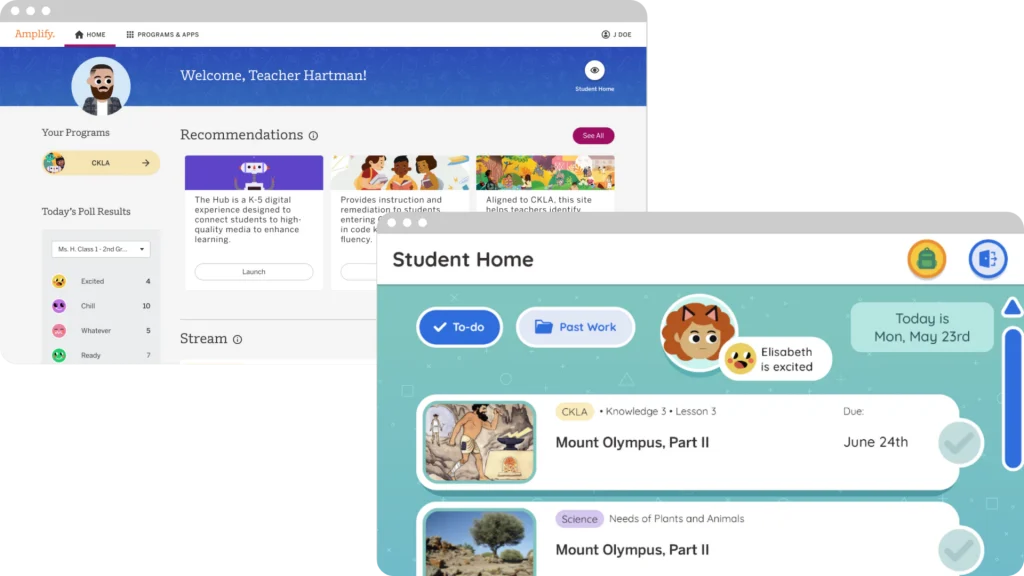
Two digital dashboards are displayed: one for teachers showing recommendations and a program list, and one for students showing to-do items and a lesson named Mount Olympus, Part II.

With the digital experience, everything is in one place, making it easier and more engaging than ever to plan lessons, present digital content, and review student work. Click the arrows below to learn more.

With the digital experience, teachers have access to ready-to-use and customizable lesson presentation slides, complete with all the prompts from the print Teacher Guide embedded in the teacher view. As teachers deliver each lesson, students can engage with the content in one cohesive experience—through these CKLA resources: Activity Books, slides, digital components, videos, Student Readers, and more.

The innovative live review tool found in the digital experience enables you to keep an eye on all of your students as they work on drawing, recording audio, uploading and capturing images, and typing or writing in pre-placed textboxes in their Activity Pages. This dynamic tool provides countless classroom management benefits, enabling you to spot and correct common mistakes as they’re happening, praise your students for thoughtful work, and identify students who are not engaged in the task at hand. Simply put, it will give you those valuable “eyes in the back of your head” you’ve warned your students about!

The digital experience integrates with various LMSs, allowing you and your students to access Amplify CKLA with the software you’re already comfortable using.

In the Amplify CKLA student digital experience, your students have one intuitive access point to fully engage with classroom instruction. Through the Student Home, students can easily access digital lessons with slides, Activity Pages, ebooks, videos, and other interactives from one simple dashboard. Students can draw, record audio, upload and capture images, and type or write in pre-placed text boxes in their Activity Pages.

CKLA review resources

Step 4: State Review Resources

Step 5: Program Access

Explore as a teacher

Before logging in, watch this brief video on navigating the CKLA Teacher Platform.

Ready to explore as a teacher? Follow these instructions:

  • Click the Amplify CKLA Teacher Platform button below.
  • Select Log in with Amplify.
  • Enter the teacher username: t1.utcklapk5@demo.tryamplify.net
  • Enter the teacher password: Amplify1-utcklapk5
  • Choose CKLA from the “Your Programs” menu on Educator Home.
  • Select a grade level from the drop-down menu at the top of the page.

Ready to explore as a Student? Follow these instructions:

  • Click the Amplify CKLA Teacher Platform button below.
  • Select Log in with Amplify.
  • Enter the student username: s1.utahcklapk5@demo.tryamplify.net
  • Enter the student password: Amplify1-utahcklapk5

A digital experience exclusively for Amplify CKLA 2nd Edition

Amplify Core Knowledge Language Arts (CKLA) 2nd Edition’s top-rated content is available with a digital experience that enhances instruction and saves time. With everything you need in one place, this platform makes it easier and more engaging to plan lessons, present digital content, and review student work.

Information on this page relates to Amplify CKLA 2nd Edition. Access Amplify CKLA 3rd Edition here.

A teacher presenting a slide titled "introducing the read-aloud" for a lesson on "the aztec: the legend of the eagle and the serpent," featuring colorful graphics on a computer screen.

Simplify planning and instruction

With the digital experience, teachers have access to ready-to-use and customizable lesson presentation slides, complete with all the prompts from the print Teacher Guide embedded in the teacher view. As teachers deliver each lesson, students can engage with the content in one cohesive experience—through these CKLA resources: Activity Books, slides, digital components, videos, Student Readers, and more.

Get real-time insights into your students’ work

The innovative live review tool found in the digital experience enables you to keep an eye on all of your students as they work on drawing, recording audio, uploading and capturing images, and typing or writing in pre-placed textboxes in their Activity Pages. This dynamic tool provides countless classroom management benefits, enabling you to spot and correct common mistakes as they’re happening, praise your students for thoughtful work, and identify students who are not engaged in the task at hand. Simply put, it will give you those valuable “eyes in the back of your head” you’ve warned your students about!

Learning Management System integrations

The digital experience integrates with various LMSs, allowing you and your students to access Amplify CKLA with the software you’re already comfortable using.

Engage your students with one easy-to-use access point

In the Amplify CKLA student digital experience, your students have one intuitive access point to fully engage with classroom instruction. Through the Student Home, students can easily access digital lessons with slides, Activity Pages, ebooks, videos, and other interactives from one simple dashboard. Students can draw, record audio, upload and capture images, and type or write in pre-placed text boxes in their Activity Pages.

Amplify Desmos Math for San Diego

Hello San Diego math educators,

Welcome to Amplify Desmos Math! We’re confident you’ll find this to be a powerful and effective program for getting all your students talking and thinking about math concepts together.

On this site, you’ll find a variety of resources to guide you in learning more about what Amplify Desmos Math has to offer. 

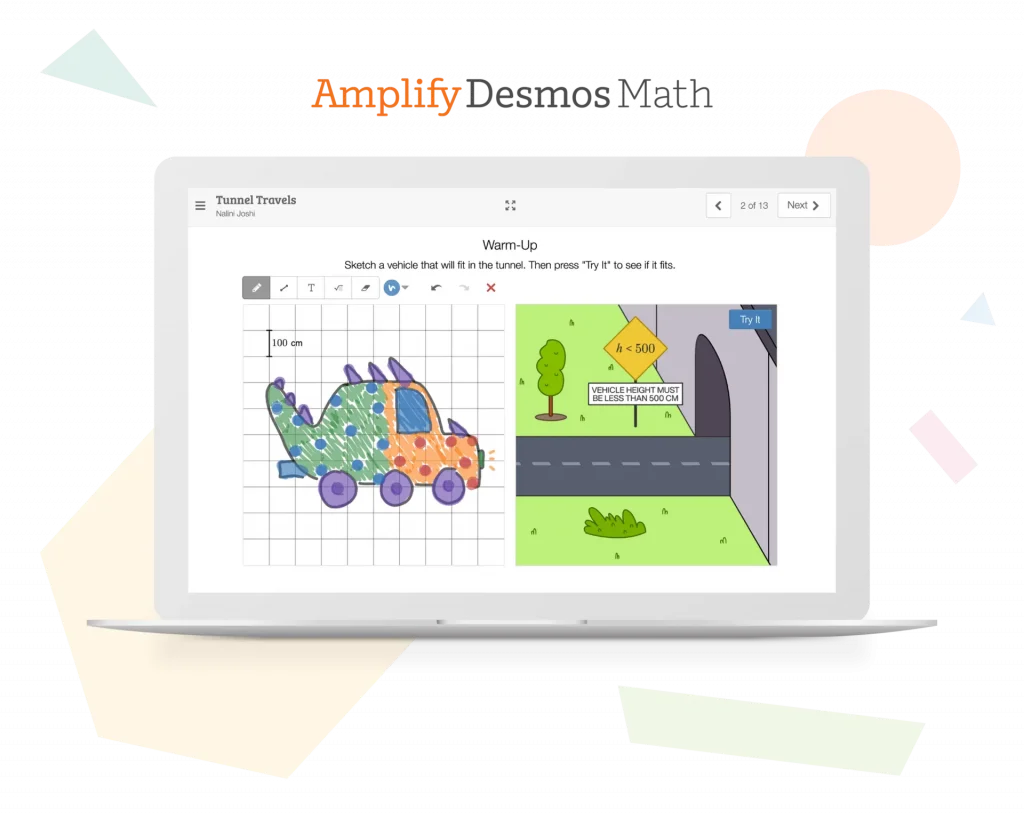
A laptop displays a math activity showing a dinosaur-shaped car on a grid and a tunnel with a height restriction sign and a tree.

Figuring out Problem-Based Learning

Figuring out how to implement a problem-based learning approach to mathematics can be fun and challenging. Rest assured that you will not be alone on this journey. Amplify will be by your side every step of the way.

In the short videos below, Fawn Nguyen (Amplify Math Specialist, Former Math Coach and Teacher) and John Hoogestraat (Desmos Product Specialist, Former Math Coach and Teacher) share their thoughts about the power of Amplify Desmos Math.

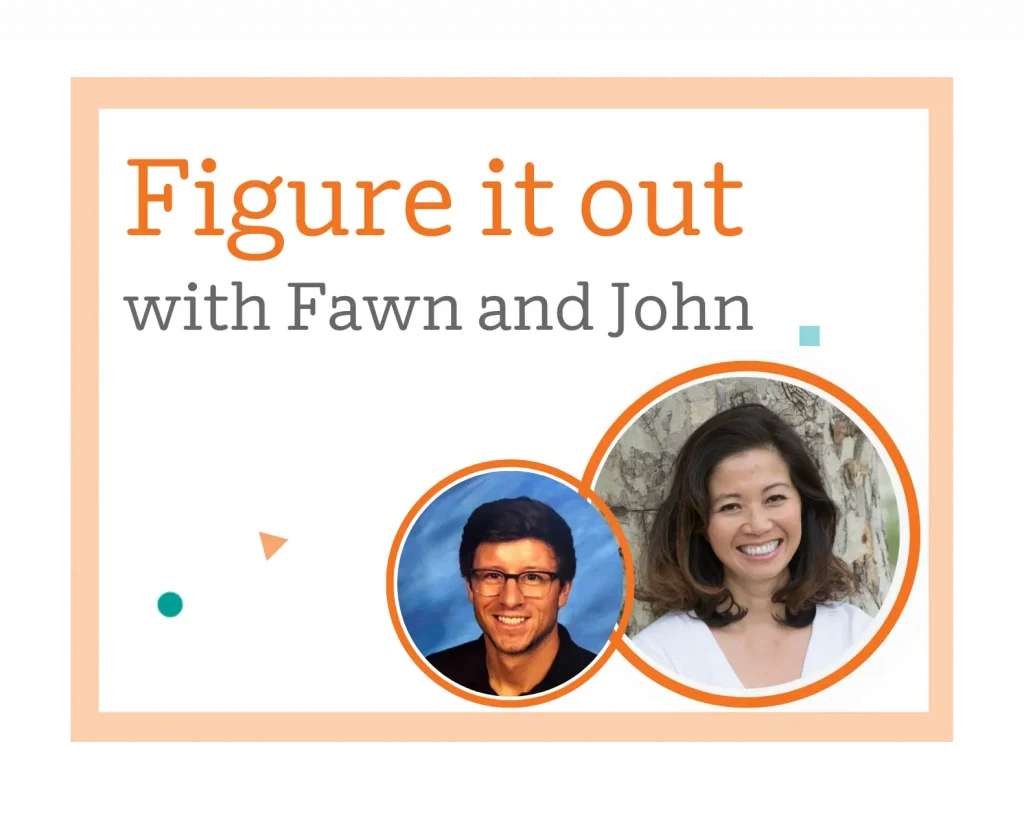
Promotional graphic with the text “Figure it out with Fawn and John” and photos of a smiling man and woman in circular frames.

Amplify Desmos Math: Supporting Math Practices

Amplify Desmos Math: Teacher Time-Saving Tools

Amplify Desmos Math: Capturing Student Thinking

Amplify Desmos Math: What a Classroom Looks and Sounds Like

About Amplify Desmos Math

Amplify Desmos Math, based on the highly-rated Illustrative Mathematics curriculum IM K–12 Math™, is designed around the idea that a core math curriculum needs to serve 100 percent of students in accessing grade-level math every day.

By joining forces with Desmos Classroom, Amplify is changing the conversation around math instruction—for both students and teachers.

  • Engaging, discourse-rich math lessons that are easier to teach.
  • Flexible, collaborative problem-solving experiences both online and off.
  • Real-time insights that make student thinking more transparent.
amplify math middle schoolers in classroom

Program highlights

Taking the IM content further

Planning for instruction

To start using Amplify Desmos Math quickly in your classroom, check out the following onboarding videos, guide, and planning resources. They cover what you need to know to get started fast.

Onboarding videos and guides

Standards Correlation

Screenshot of an educational website's dashboard, displaying colorful banners for math 6, math 7, math 8, and algebra 1 courses under the featured collections section.

Lesson Sampler

Amplify Desmos Math delivers the instructional power of student-centered learning packaged in a lesson format that is teacher-friendly and manageable.

With easy-to-follow instructional support, implementing a problem-based program becomes more effective and enjoyable for both you and your students. Paired with the Desmos Classroom digital experience, math class becomes fun and dynamic, with plenty of opportunities for students to talk through their reasoning, work with their peers, and gain new understandings.

A desktop screen displaying various educational graphs and charts, including trajectory and bar graphs, with icons and text details related to Desmos math lessons.

Additional features

Universal design

Every student is brilliant, and every student has brilliant mathematical ideas worth sharing and cultivating. Incorporating principles of Universal Design for Learning (UDL) into lessons brings their brilliance to the forefront. UDL is a research-based framework designed to ensure that all learners can access and participate in meaningful, challenging learning opportunities.

A feedback form with two questions, "How well did you understand the math in this lesson?" and "How did you feel about learning math in this lesson?" with corresponding emoji options for responses, perfectly complements the New York Math curriculum.

Diversity and representation

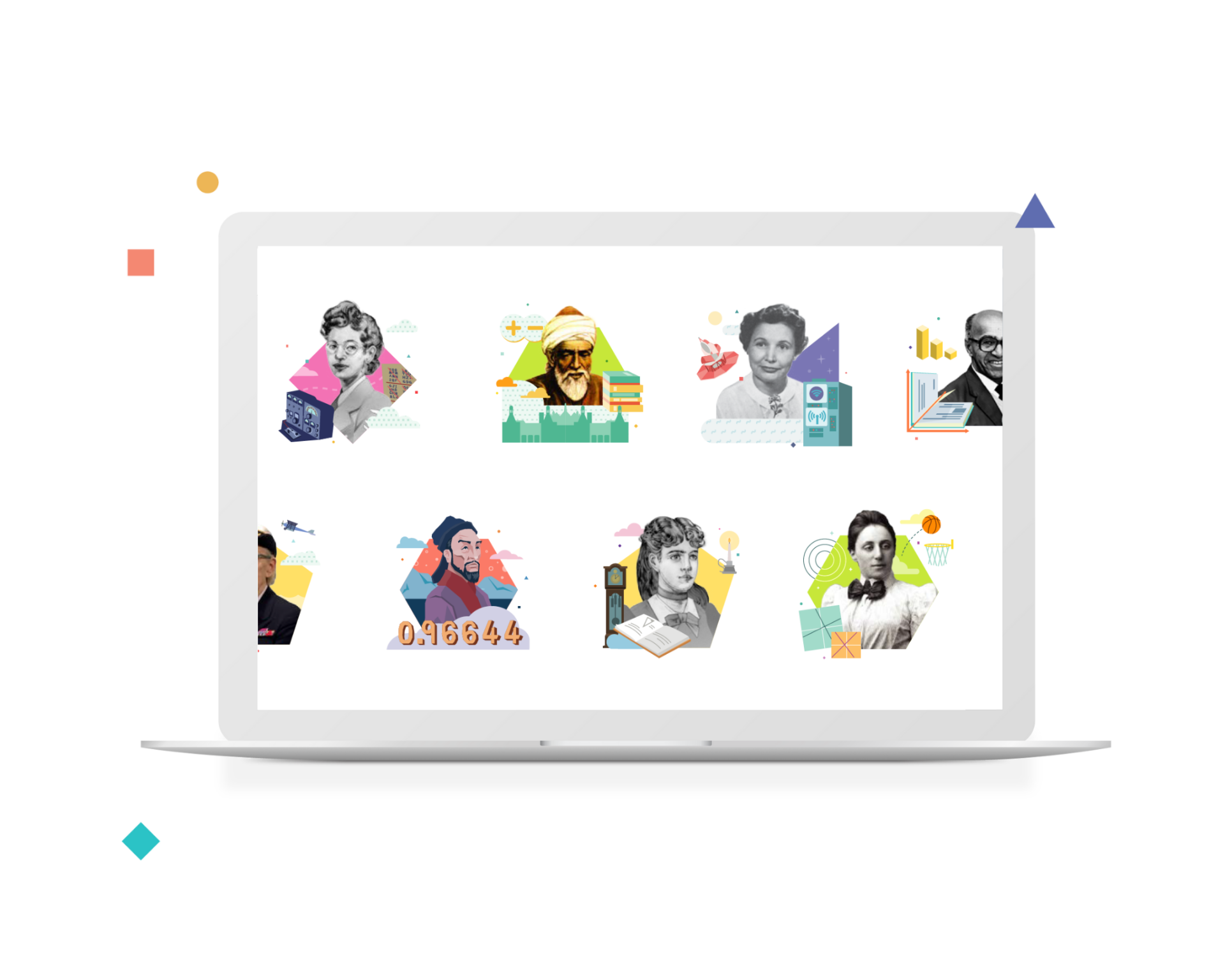
Helping students develop strong, healthy, and flexible math identities is a cornerstone of our program. Throughout the curriculum, students will be taught that they themselves are mathematicians, that today’s math was largely shaped by a diverse range of mathematicians who deserve to be learned about, and that learning is never finished.

Illustration of a laptop displaying various colorful icons and graphics representing diverse professions and historical figures on its screen, emphasizing illustrative mathematics and desmos math concepts through its displayed content.

Assessments

Less exciting, but essential for learning—assessments. Amplify Desmos Math will feature a robust variety of formative and summative assessments, including: readiness checks, exit tickets, quizzes, end-of-unit tests, benchmarks, and CAASPP practice.

Illustration of a laptop displaying various colorful icons and graphics representing diverse professions and historical figures on its screen, emphasizing illustrative mathematics and desmos math concepts through its displayed content.

Reporting

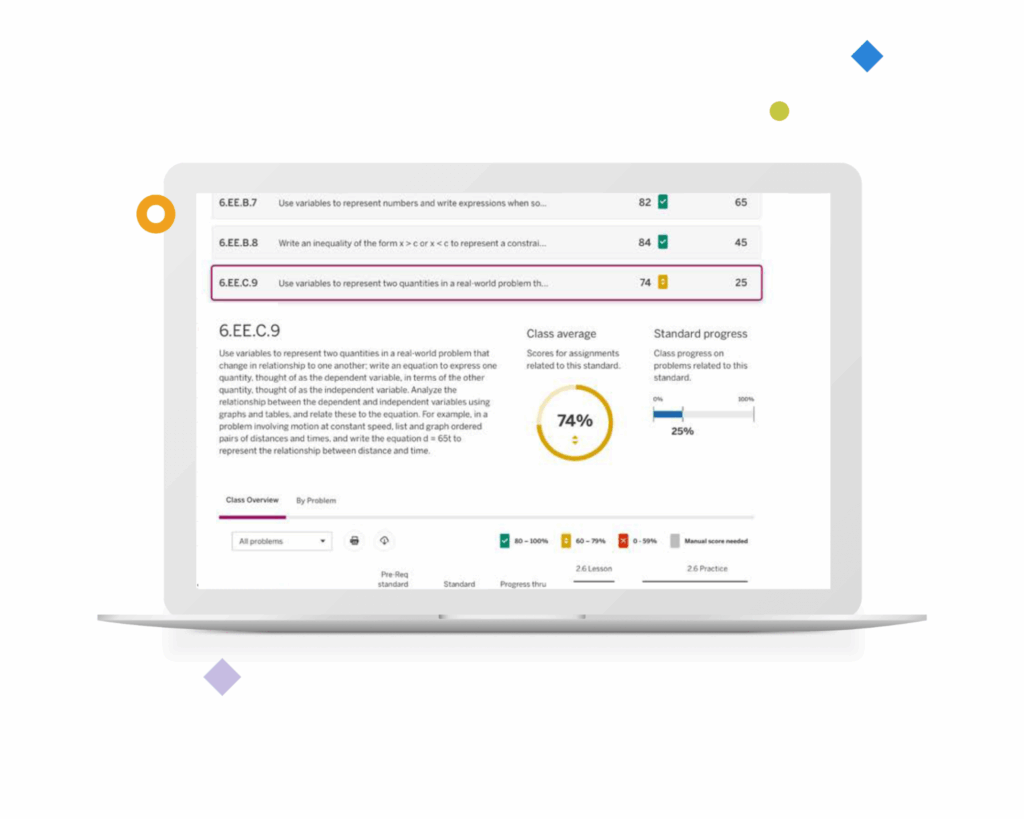
Not only will our reports show progress toward standards mastery, they will include detail on how students performed against the standard in the past and how many more encounters are yet to come. This feature alone helps teachers prioritize instruction and intervene with additional resources when necessary.

A computer screen displays a New York math skills tracking interface, highlighting standard 6.EE.C.9, with progress indicators and a class average score of 74% shown in a yellow pie chart.

Featuring Desmos Math 6–A1

Desmos Math 6–8 is based on the highly rated IM K–12™ curricula from Illustrative Mathematics. It has also earned a perfect all-green rating by EdReports.

Read the review on EdReports.

Unlike other IM-based lessons, ours require less prep and are easier to teach. Plus, our more visually rich activities and engaging on-ramps to learning make our lessons accessible to all students.

Digital educational slide adhering to the core curriculum, showcasing a fishbowl on a table, clock on the wall at 8:00, and window with curtains, next to a math problem about

Desmos Classroom digital lessons

Digital lessons should be powerful in their ability to surface student thinking and spark interesting and productive discussions. We’ve joined forces with Desmos Classroom to bring this vision to life with a complete library of interactive, collaborative lessons.

Screenshot of an educational module titled "Balloon Float" on Desmos Classroom. It focuses on proportional relationships with tables and lists goals related to quantities, patterns, and numerical relationships.

Engaging student experience

Relevant content and interactive math tools create an intuitive and engaging student experience. Plus, working together in real-time allows students to see that communicating their ideas and learning from each other are important parts of math class.

A screenshot of an educational software showing a turtle race. Users write equations for four turtles to determine their speed. Lane 4 is empty, waiting for an equation to be written. Graph and table included.


Visibility into student thinking

Imagine having more visibility into your students’ mathematical thinking. Now imagine students have access to this same information. With our collaborative lesson interface and teacher dashboard, students can’t hide. What’s more, they have visibility into the thinking of their peers—exposing them to a wider variety of approaches to solving the same problem.

Laptop screen displaying an illustrative mathematics pattern on a grid in a graphics editing software interface, with annotations and tool icons visible.

Ready-to-teach lessons

Each grade-level includes 150 ready-to-teach lessons complete with slides, step-by-step teaching notes, suggested student and teacher responses, tips for incorporating instructional routines, support for developing mathematical language, and links to useful resources. Teachers can also control what slides students see, giving teachers the ability to control the pace of the lesson to suite the needs of the class.

A screenshot displays a Pizza Maker educational tool. Four pizzas are shown, and a question about oven temperature for multiple pizzas is posed. Various student responses are visible below.


Looking for help?

Our chat agents are standing by to assist you!
Simply log in at learning.amplify.com and click the orange button in the bottom right corner to chat live with our support team.

Important to Note
Our support hours are Monday through Friday, 4 a.m. to 4 p.m. PT.

Don’t have a login yet?
Email us: help@amplify.com
Call us: +1 (800) 823-1969

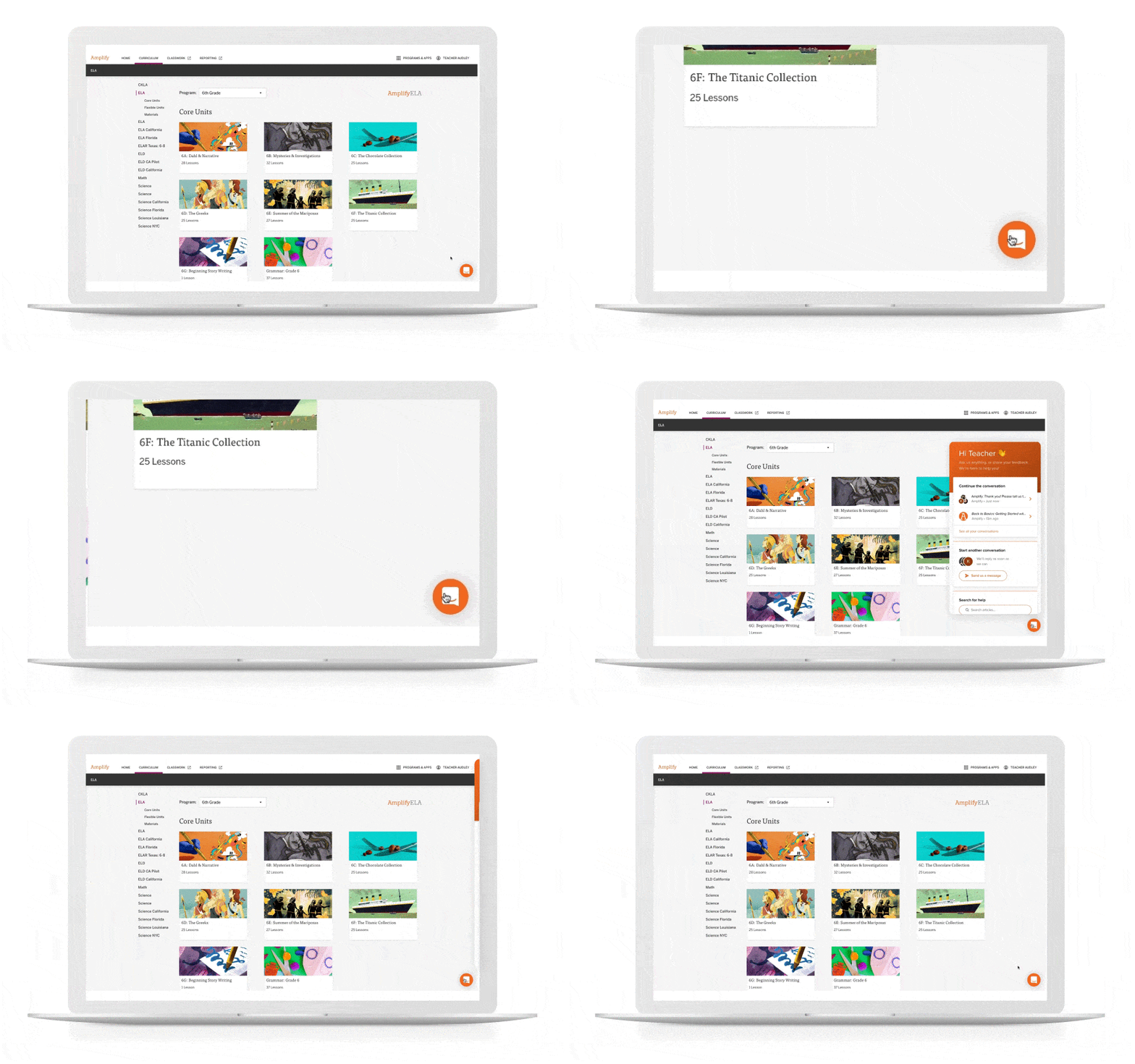
A laptop screen displays a curriculum dashboard with a list of core units and colorful thumbnails for a sixth-grade ELA program.

Welcome, Lake Washington reviewers!

To view this protected page, enter the password below:


Corona-Norco Unified School District

To view this protected page, enter the password below:


Amplify ELA – Atlanta Review3

To view this protected page, enter the password below:


CKLA Review for Scottsdale

Thank you for taking the time to review Amplify’s core ELA program for K–5.

Amplify Core Knowledge Language Arts (CKLA) is a cutting-edge and effective core ELA program for students in grades K–5. It was developed in partnership with the Core Knowledge Foundation, was specifically designed to help teachers implement Science of Reading principles, and features proven evidence-based instructional practices.

Step 1: Program Introduction

Welcome to Amplify CKLA! Before you dive into our materials, watch the video below to learn about the big picture behind Amplify CKLA’s pedagogy.

In this video, Susan Lambert (Chief Academic Officer and host of Science of Reading: The Podocast) shares why Amplify CKLA was created, how it is built on the Science of Reading, and the impact it’s making across the country.

Step 2: Program Overview

Amplify CKLA is different for a reason. Watch the overview video below to learn about these differences and why educators love them.

In this video, you’ll get an in-depth look at the program’s overall structure and organization, the design behind our proven lessons, and the materials included to support teaching and learning.

The Amplify CKLA Program Guide also provides an in-depth view of how Amplify CKLA works, how it’s structured, and why it’s uniquely capable of helping you bring reading instruction based on the Science of Reading to your classroom.

Evidence-based design

Amplify CKLA is rooted in Science of Reading research. Mirroring Scarborough’s Rope, Amplify CKLA delivers a combination of explicit foundational skills with meaningful knowledge-building.

  • In Grades PK–2, dedicated knowledge-building and explicit skills instruction are taught simultaneously through two distinct instructional strands.
  • In Grades 3–5, dedicated knowledge-building and explicit skills instruction are woven together and delivered through one integrated strand.

Grades K–2 Skills and Knowledge Strands
Every day students in Grades K–2 complete one full lesson that explicitly and systematically builds foundational reading skills in the Skills Strand, as well as one full lesson that builds robust background knowledge to access complex text in the Knowledge Strand. Through learning in each of these strands, students develop the early literacy skills necessary to help them become confident readers and build the context to understand what they’re reading.

Grades 3–5 Integrated Strand
In Grades 3–5, Knowledge and Skills are integrated in one set of instructional materials. Lessons begin to combine skills and knowledge with increasingly complex texts, close reading, and a greater writing emphasis. Students can then use their skills to go on their own independent reading adventures.

Key features

Built out of the latest research in the Science of Reading, Amplify CKLA delivers explicit instruction in both foundational literacy skills (systematic phonics, decoding, and fluency) and background knowledge in grades K–2 with an integrated approach to explicit instruction in grades 3–5.

Review this Science of Reading toolkit to learn more about the Science of Reading best practices integrated throughout CKLA.

Great reading instruction starts with helping kids develop great decoding skills. By building a solid foundation of phonological awareness and phonics, reading the words on the page becomes automatic so that comprehension and critical thinking can happen. Our instruction is supported by:

  • Step-by-step lessons with multi-sensory approaches, clear lesson objectives, and embedded formative assessments.
  • Decodable books and student readers with ebook and audiobook versions that feature engaging plots and relatable characters.
  • An engaging sound library with fun songs and videos that develop phonological awareness.
  • An interactive Vocab App featuring engaging activities with immediate feedback and automated, customized instruction based on student performance.

Students build grade-appropriate subject-area knowledge and vocabulary in history, science, literature, and the arts while learning to read, write, and think creatively and for themselves. Our instruction is supported by:

  • Knowledge builders that provide a quick overview of each domain with its key ideas.
  • Interactive Read-Alouds designed to build knowledge and vocabulary.
  • Content-rich anchor texts that support students as they tackle increasingly complex text and sharpen their analytical skills.
  • Social and emotional learning paired with lessons in civic responsibility.

Getting students caught up on reading skills requires more than just an extra mini-lesson here or there. It requires targeted and intensive instruction delivered in short bursts. Our intervention component:

  • Assesses and analyzes students’ areas of mastery and growth.
  • Automatically groups students with like needs.
  • Provides educators with ready-to-teach, research-based instructional progressions that last 10-days.
  • Progress monitors students, updates their skill profiles, and reforms groups for the next 10-day period.

Student-led reading practice should be purposeful and connected to the core. In addition to practicing skills directly tied to the skills they’ve been working on during ELA time, Amplify CKLA students have opportunities to interact with adaptive content that addresses their personal gaps and bolsters foundational skills at a pace that supports their individual development.

Our collection of 40+ adaptive games target foundational reading skills and develops them in alignment with Science of Reading principles. Unlike other adaptive games, we ensure students:

  • Practice the right skills at the right time. Our embedded placement tool ensures students receive the content and skill practice most appropriate for their current reading level. From there, students move through our curriculum along their own learning pathway where they encounter personalized content tailored to their evolving skill and grade levels.
  • Progress along a pathway that adapts on multiple dimensions, not just one. For example, a student can work on early first-grade decoding in one game while building more advanced vocabulary knowledge in another.
  • Practice skills in tandem. For example, a student is never forced to master one skill area before proceeding to the next. Instead, we offer students that opportunity to work on multiple skills concurrently.
  • Feel supported with scaffolding, instruction, and practice that adapts based on student performance.
  • Stay engaged by giving them immediate and clear feedback. These results are never punitive. Instead our always-positive feedback is delivered in the context of the game world and is designed to motivate students to keep trying.

From the printed page to the screen, we bring foundational skills and knowledge to life in the classroom.

Download the Amplify CKLA Components guide to see components by grade.

Download the Remote and hybrid learning guide to learn how we support in-person, remote, and hybrid instruction.

Engaging digital experience

The top-rated content of Amplify CKLA is now live with the digital experience that enhances instruction and saves time.

With the digital experience, everything is in one place, making it easier and more engaging than ever to plan lessons, present digital content, and review student work. Click the arrows below to learn more.

With the digital experience, teachers have access to ready-to-use and customizable lesson presentation slides, complete with all the prompts from the print Teacher Guide embedded in the teacher view. As teachers deliver each lesson, students can engage with the content in one cohesive experience—through these CKLA resources: Activity Books, slides, digital components, videos, Student Readers, and more.

The innovative live review tool found in the digital experience enables you to keep an eye on all of your students as they work on drawing, recording audio, uploading and capturing images, and typing or writing in pre-placed textboxes in their Activity Pages. This dynamic tool provides countless classroom management benefits, enabling you to spot and correct common mistakes as they’re happening, praise your students for thoughtful work, and identify students who are not engaged in the task at hand. Simply put, it will give you those valuable “eyes in the back of your head” you’ve warned your students about!

The digital experience integrates with various LMSs, allowing you and your students to access Amplify CKLA with the software you’re already comfortable using.

In the Amplify CKLA student digital experience, your students have one intuitive access point to fully engage with classroom instruction. Through the Student Home, students can easily access digital lessons with slides, Activity Pages, ebooks, videos, and other interactives from one simple dashboard. Students can draw, record audio, upload and capture images, and type or write in pre-placed text boxes in their Activity Pages.

Step 3: Program Resources

Digital navigation walkthrough

Physical materials walkthrough

Step 4: Arizona Review Resources

Arizona resources:

CKLA review resources:

Step 5: Demo Program Access

Explore as a teacher

Before logging in, watch this brief video on navigating the CKLA Teacher Platform.

Ready to explore as a teacher? Follow these instructions:

  • Click the Amplify CKLA Teacher Platform button below.
  • Select Log in with Amplify.
  • Enter the teacher username: t1.scottsdaleunified@demo.tryamplify.net
  • Enter the password: Amplify1-scottsdaleunified
  • Click the CKLA icon.
  • Select a grade level from the drop-down menu at the top of the page.

Explore as a student

Before logging in, watch this brief video on navigating the CKLA Student Hub.

Ready to explore as a student? Follow these instructions:

  • Click the CKLA Student Hub button below.
  • Select Log in with Amplify.
  • Enter the student username: s1.scottsdaleunified@demo.tryamplify.net
  • Enter the password: Amplify1-scottsdaleunified
  • Click the Hub icon
  • Select a grade level.

Welcome, Granite SD, to Amplify CKLA!

Thank you for taking the time to review Amplify’s core ELA program for K–5. Amplify Core Knowledge Language Arts® (CKLA) is a state-approved core ELA curriculum designated as a primary core program that fully meets the Science of Reading requirements outlined in SB 127.

Amplify CKLA, developed in partnership with the Core Knowledge Foundation, was designed to help teachers implement Science of Reading principles and evidence-based instructional practices. Scroll down to learn how CKLA is uniquely designed to help all your students make learning leaps in literacy.

Step 1: Program Introduction

Welcome to Amplify CKLA! Before you dive into our materials, watch the video below to learn about the big picture behind Amplify CKLA’s pedagogy.

In this video, Susan Lambert (Chief Academic Officer and host of Science of Reading: The Podcast) shares why Amplify CKLA was created, how it is built on the Science of Reading, and the impact it’s making across the country.

Step 2: Program Overview

Amplify CKLA is different for a reason. Watch the overview video below to learn about these differences and why educators love them.

In this video, you’ll get an in-depth look at the program’s overall structure and organization, the design behind our proven lessons, and the materials included to support teaching and learning.

The Amplify CKLA Program Guide also provides an in-depth view of how Amplify CKLA works, how it’s structured, and why it’s uniquely capable of helping you bring reading instruction based on the Science of Reading to your classroom.

Evidence-based design

Amplify CKLA is rooted in Science of Reading research. Mirroring Scarborough’s Rope, Amplify CKLA delivers a combination of explicit foundational skills with meaningful knowledge-building.

  • In Grades K–2, dedicated knowledge-building and explicit skills instruction are taught simultaneously through two distinct instructional strands.
  • In Grades 3–5, dedicated knowledge-building and explicit skills instruction are woven together and delivered through one integrated strand.

Grades K–2 Skills and Knowledge Strands
Every day students in Grades K–2 complete one full lesson that explicitly and systematically builds foundational reading skills in the Skills Strand, as well as one full lesson that builds robust background knowledge to access complex text in the Knowledge Strand. Through learning in each of these strands, students develop the early literacy skills necessary to help them become confident readers and build the context to understand what they’re reading.

Grades 3–5 Integrated Strand
In Grades 3–5, Knowledge and Skills are integrated in one set of instructional materials. Lessons begin to combine skills and knowledge with increasingly complex texts, close reading, and a greater writing emphasis. Students can then use their skills to go on their own independent reading adventures.

Key features

For each Amplify CKLA key feature below, click the drop down arrow to learn more.

Built out of the latest research in the Science of Reading, Amplify CKLA delivers explicit instruction in both foundational literacy skills (systematic phonics, decoding, and fluency) and background knowledge in grades K–2 with an integrated approach to explicit instruction in grades 3–5.

Review this Science of Reading toolkit to learn more about the Science of Reading best practices integrated throughout CKLA.

Amplify CKLA aligns with the instructional principles recommended by Orton Gillingham and LETRS.

  • Structured–Concepts are taught through consistent routines
  • Sequential–Concepts are taught in a logical, well-planned sequence
  • Systematic–Phonemes are taught from simplest to most complex
  • Explicit–Decoding and encoding concepts are taught directly and explicitly
  • Multi-sensory–Instruction is delivered through visual, auditory, and kinesthetic-tactile pathways
  • Cumulative–Concepts are applied in decodable, connected texts with constant review and reinforcement

Watch this video to learn more!

Additionally, great reading instruction starts with helping kids develop great decoding skills. Our instruction is supported by:

The Science of Reading reveals knowledge as an essential pillar of reading comprehension and lifelong literacy. Hear from author Natalie Wexler and CKLA customers on edWebinar about the importance of knowledge-building in reading instruction.

Students build grade-appropriate subject-area knowledge and vocabulary in history, science, literature, and the arts while learning to read, write, and think creatively and for themselves. Our instruction is supported by:

  • Knowledge builders that provide a quick overview of each domain with its key ideas.
  • Interactive Read-Alouds designed to build knowledge and vocabulary.
  • Content-rich anchor texts that support students as they tackle increasingly complex text and sharpen their analytical skills.
  • Social and emotional learning paired with lessons in civic responsibility.

Amplify CKLA not only received an all-green rating from the rigorous evaluators at EdReports, but it was also recently recognized by the Knowledge Matters Campaign as a high-quality literacy program that excels in building knowledge. Our shared message: background knowledge is essential to literacy and learning.

Student-led reading practice should be purposeful and connected to the core. That’s why Amplify createdBoost Reading. As an optional add-on to Amplify CKLA, students have the opportunity to practice skills directly tied to the skills they’ve been working on during core reading time. Boost Reading also adapts to each student to address their personal gaps and bolsters foundational skills at a pace that supports their individual development.

Boost Reading’s collection of 40+ adaptive games target foundational reading skills and develops them in alignment with Science of Reading principles. Unlike other adaptive games, we ensure students:

  • Practice the right skills at the right time. Our embedded placement tool ensures students receive the content and skill practice most appropriate for their current reading level. From there, students move through our curriculum along their own learning pathway where they encounter personalized content tailored to their evolving skill and grade levels.
  • Progress along a pathway that adapts on multiple dimensions, not just one. For example, a student can work on early first-grade decoding in one game while building more advanced vocabulary knowledge in another.
  • Practice skills in tandem. For example, a student is never forced to master one skill area before proceeding to the next. Instead, we offer students that opportunity to work on multiple skills concurrently.
  • Feel supported with scaffolding, instruction, and practice that adapts based on student performance.
  • Stay engaged by giving them immediate and clear feedback. These results are never punitive. Instead our always-positive feedback is delivered in the context of the game world and is designed to motivate students to keep trying.

Click the buttons below to learn more:

Step 3: Program Resources

Easy-to-use print materials

Amplify CKLA’s easy-to-use materials bring foundational skills and knowledge to life in the classroom.

Download the Amplify CKLA Components guide to see components by grade and watch the print materials walkthrough below.

Engaging CKLA digital experience

The top-rated content of Amplify CKLA is now live with the digital experience that enhances instruction and saves time.

With the digital experience, everything is in one place, making it easier and more engaging than ever to plan lessons, present digital content, and review student work. Click the arrows below to learn more.

With the digital experience, teachers have access to ready-to-use and customizable lesson presentation slides, complete with all the prompts from the print Teacher Guide embedded in the teacher view. As teachers deliver each lesson, students can engage with the content in one cohesive experience—through these CKLA resources: Activity Books, slides, digital components, videos, Student Readers, and more.

The innovative live review tool found in the digital experience enables you to keep an eye on all of your students as they work on drawing, recording audio, uploading and capturing images, and typing or writing in pre-placed textboxes in their Activity Pages. This dynamic tool provides countless classroom management benefits, enabling you to spot and correct common mistakes as they’re happening, praise your students for thoughtful work, and identify students who are not engaged in the task at hand. Simply put, it will give you those valuable “eyes in the back of your head” you’ve warned your students about!

The digital experience integrates with various LMSs, allowing you and your students to access Amplify CKLA with the software you’re already comfortable using.

In the Amplify CKLA student digital experience, your students have one intuitive access point to fully engage with classroom instruction. Through the Student Home, students can easily access digital lessons with slides, Activity Pages, ebooks, videos, and other interactives from one simple dashboard. Students can draw, record audio, upload and capture images, and type or write in pre-placed text boxes in their Activity Pages.

CKLA review resources

Step 4: State Review Resources

Step 5: Program Access

Explore as a teacher

Before logging in, watch this brief video on navigating the CKLA Teacher Platform.

Ready to explore as a teacher? Follow these instructions:

  • Click the Amplify CKLA Teacher Platform button below.
  • Select Log in with Amplify.
  • Enter the teacher username: t1.graniteckla@demo.tryamplify.net
  • Enter the teacher password: Amplify1-graniteckla
  • Choose CKLA from the “Your Programs” menu on Educator Home.
  • Select a grade level from the drop-down menu at the top of the page.

CKLA Review for Arizona

Thank you for taking the time to review Amplify’s core ELA program for K–5.

Amplify Core Knowledge Language Arts (CKLA) is a cutting-edge and effective core ELA program for students in grades K–5. It was developed in partnership with the Core Knowledge Foundation, was specifically designed to help teachers implement Science of Reading principles, and features proven evidence-based instructional practices.

Step 1: Program Introduction

Welcome to Amplify CKLA! Before you dive into our materials, watch the video below to learn about the big picture behind Amplify CKLA’s pedagogy.

In this video, Susan Lambert (Chief Academic Officer and host of Science of Reading: The Podcast) shares why Amplify CKLA was created, how it is built on the Science of Reading, and the impact it’s making across the country.

Step 2: Program Overview

Amplify CKLA is different for a reason. Watch the overview video below to learn about these differences and why educators love them.

In this video, you’ll get an in-depth look at the program’s overall structure and organization, the design behind our proven lessons, and the materials included to support teaching and learning.

The Amplify CKLA Program Guide also provides an in-depth view of how Amplify CKLA works, how it’s structured, and why it’s uniquely capable of helping you bring reading instruction based on the Science of Reading to your classroom.

Evidence-based design

Amplify CKLA is rooted in Science of Reading research. Mirroring Scarborough’s Rope, Amplify CKLA delivers a combination of explicit foundational skills with meaningful knowledge-building.

  • In Grades K–2, dedicated knowledge-building and explicit skills instruction are taught simultaneously through two distinct instructional strands.
  • In Grades 3–5, dedicated knowledge-building and explicit skills instruction are woven together and delivered through one integrated strand.

Grades K–2 Skills and Knowledge Strands
Every day students in Grades K–2 complete one full lesson that explicitly and systematically builds foundational reading skills in the Skills Strand, as well as one full lesson that builds robust background knowledge to access complex text in the Knowledge Strand. Through learning in each of these strands, students develop the early literacy skills necessary to help them become confident readers and build the context to understand what they’re reading.

Grades 3–5 Integrated Strand
In Grades 3–5, Knowledge and Skills are integrated in one set of instructional materials. Lessons begin to combine skills and knowledge with increasingly complex texts, close reading, and a greater writing emphasis. Students can then use their skills to go on their own independent reading adventures.

Key features

Built out of the latest research in the Science of Reading, Amplify CKLA delivers explicit instruction in both foundational literacy skills (systematic phonics, decoding, and fluency) and background knowledge in grades K–2 with an integrated approach to explicit instruction in grades 3–5.

Review this Science of Reading toolkit to learn more about the Science of Reading best practices integrated throughout CKLA.

Great reading instruction starts with helping kids develop great decoding skills. By building a solid foundation of phonological awareness and phonics, reading the words on the page becomes automatic so that comprehension and critical thinking can happen. Our instruction is supported by:

  • Step-by-step lessons with multi-sensory approaches, clear lesson objectives, and embedded formative assessments.
  • Decodable books and student readers with ebook and audiobook versions that feature engaging plots and relatable characters.
  • An engaging sound library with fun songs and videos that develop phonological awareness.
  • An interactive Vocab App featuring engaging activities with immediate feedback and automated, customized instruction based on student performance.

Students build grade-appropriate subject-area knowledge and vocabulary in history, science, literature, and the arts while learning to read, write, and think creatively and for themselves. Our instruction is supported by:

  • Knowledge builders that provide a quick overview of each domain with its key ideas.
  • Interactive Read-Alouds designed to build knowledge and vocabulary.
  • Content-rich anchor texts that support students as they tackle increasingly complex text and sharpen their analytical skills.
  • Lessons in civic responsibility.

Getting students caught up on reading skills requires more than just an extra mini-lesson here or there. It requires targeted and intensive instruction delivered in short bursts. Our intervention component:

  • Assesses and analyzes students’ areas of mastery and growth.
  • Automatically groups students with like needs.
  • Provides educators with ready-to-teach, research-based instructional progressions that last 10-days.
  • Progress monitors students, updates their skill profiles, and reforms groups for the next 10-day period.

Student-led reading practice should be purposeful and connected to the core. In addition to practicing skills directly tied to the skills they’ve been working on during ELA time, Amplify CKLA students have opportunities to interact with adaptive content that addresses their personal gaps and bolsters foundational skills at a pace that supports their individual development.

Our collection of 40+ adaptive games target foundational reading skills and develops them in alignment with Science of Reading principles. Unlike other adaptive games, we ensure students:

  • Practice the right skills at the right time. Our embedded placement tool ensures students receive the content and skill practice most appropriate for their current reading level. From there, students move through our curriculum along their own learning pathway where they encounter personalized content tailored to their evolving skill and grade levels.
  • Progress along a pathway that adapts on multiple dimensions, not just one. For example, a student can work on early first-grade decoding in one game while building more advanced vocabulary knowledge in another.
  • Practice skills in tandem. For example, a student is never forced to master one skill area before proceeding to the next. Instead, we offer students that opportunity to work on multiple skills concurrently.
  • Feel supported with scaffolding, instruction, and practice that adapts based on student performance.
  • Stay engaged by giving them immediate and clear feedback. These results are never punitive. Instead our always-positive feedback is delivered in the context of the game world and is designed to motivate students to keep trying.

From the printed page to the screen, we bring foundational skills and knowledge to life in the classroom.

Download the Amplify CKLA Components guide to see components by grade.

Download the Remote and hybrid learning guide to learn how we support in-person, remote, and hybrid instruction.

Engaging digital experience

The top-rated content of Amplify CKLA is now live with the digital experience that enhances instruction and saves time.

With the digital experience, everything is in one place, making it easier and more engaging than ever to plan lessons, present digital content, and review student work.

With the digital experience, teachers have access to ready-to-use and customizable lesson presentation slides, complete with all the prompts from the print Teacher Guide embedded in the teacher view. As teachers deliver each lesson, students can engage with the content in one cohesive experience—through these CKLA resources: Activity Books, slides, digital components, videos, Student Readers, and more.

The innovative live review tool found in the digital experience enables you to keep an eye on all of your students as they work on drawing, recording audio, uploading and capturing images, and typing or writing in pre-placed textboxes in their Activity Pages. This dynamic tool provides countless classroom management benefits, enabling you to spot and correct common mistakes as they’re happening, praise your students for thoughtful work, and identify students who are not engaged in the task at hand. Simply put, it will give you those valuable “eyes in the back of your head” you’ve warned your students about!

The digital experience integrates with various LMSs, allowing you and your students to access Amplify CKLA with the software you’re already comfortable using.

In the Amplify CKLA student digital experience, your students have one intuitive access point to fully engage with classroom instruction. Through the Student Home, students can easily access digital lessons with slides, Activity Pages, ebooks, videos, and other interactives from one simple dashboard. Students can draw, record audio, upload and capture images, and type or write in pre-placed text boxes in their Activity Pages.

Step 3: Program Resources

Digital navigation walkthrough

Physical materials walkthrough

Step 4: Arizona Review Resources

Arizona resources:

CKLA review resources:

Amplify Desmos Math for the Archdiocese of Miami

Welcome Catholic school educators, 

Amplify Desmos Math thoughtfully combines conceptual understanding, procedural fluency, and application. Each math lesson is designed to tell a story by posing problems that invite a variety of approaches before guiding students to synthesize their understanding of the learning goals.

What is Amplify Desmos Math?

Amplify Desmos Math supports teachers in building students’ lifelong math proficiency. The program:

  • Supports social classrooms, invites mathematical creativity, and evokes wonder, creating a welcoming learning space where students are empowered to see themselves and their classmates as having brilliant mathematical ideas.
  • Provides teachers with clear, step-by-step moves to build systematically from students’ prior knowledge to grade-level learning.
  • Connects students to each other’s thinking and to an understanding that they can use math to make sense of the world.
  • Enables access to grade-level understanding for every student, every day.

A powerful suite of math resources

Amplify Desmos Math combines the best of problem-based lessons, intervention, personalized practice, and assessments into a coherent and engaging experience for both students and teachers.

Data informs instruction. Comprehensive student profiles provide full data on students’ assets and skills, empowering teachers to provide just-in-time scaffolds throughout core instruction and targeted intervention when needed.

Ready to Explore?

Ready to explore as a teacher? Follow these instructions:

Ready to explore as a student? Follow these instructions:

Educational software interface featuring a New York math problem about measuring platform heights using a 9-inch tube, illustrated with a playful, colorful design.

Experience Amplify Desmos Math

Click the links below to explore our interactive digital lessons, where you’ll also find print Teacher Edition and Student Edition pages for each lesson.

For helpful navigation tips and more program information, download our Grades K–5 and Grades 6–Algebra 1 program guides.

You can also watch a product expert walk through a lesson and the available program components with a lesson walkthrough video.

Personalized learning and support

Amplify Desmos Math includes digital, adaptive practice that provides the personalized support a student needs to access grade-level math every day. Personalized Learning activities target a skill or concept aligned to the day’s core lesson, with each student receiving personalized scaffolds based on what they already know. This technology complements daily learning and provides another layer of support to the in-lesson differentiation and instructional guidance provided to teachers. Click here to try a Boost Personalized Learning activity. More activities coming soon!

The Fluency Practice of Amplify Desmos Math uses an evidence-based approach to memory retention—spaced repetition—for the basic operations. Students around the world have answered more than 120 million multiplication questions within our application. Try it now! 

Educational software on a laptop screen showing a student activity to complete a bar graph by categorizing dragonflies, designed for the New York math curriculum.

Contact us

Support is always available. Our team is dedicated to helping you every step of the way. Contact your dedicated Florida representative here for program access, samples, and additional information.

A smiling man with short hair wears a green polo shirt against a plain background, exuding the kind of confidence that comes from teaching an inspiring math lesson.

Jeff Rutter

Field Manager
Miami-Dade and Monroe Counties
jrutter@amplify.com
(727) 407-5801

A smiling person with long blonde hair wears a textured blue top against a plain background, embodying the essence of personalized learning.

Amanda Shelley

Account Executive
Broward County Schools
ashelley@amplify.com
(321)-693-3518

A man with short, dark hair and a full beard smiles confidently. He is wearing a pink patterned shirt and a green jacket, reminiscent of an engaging math lesson. The light gray background subtly complements his dynamic style.

Tom Gantt

District Manager
Miami Resident
tgantt@amplify.com
(305)-546-2979

Welcome, Atlanta reviewers!

To view this protected page, enter the password below:


Welcome, San Diego reviewers!

To view this protected page, enter the password below:


Coming soon for 2023!

The Amplify Caminos digital experience

Launching for the 2023 school year, Amplify Caminos will include a digital experience that enhances instruction and saves you time. With the digital experience, everything you need will be in one place, making it easier and more engaging than ever to plan lessons, present digital content, and review student work.

Scroll down to explore how the digital experience works for Amplify CKLA—the English language arts counterpart to Caminos.

Simplify planning and instruction

With the digital experience, teachers have access to ready-to-use and customizable lesson presentation slides, complete with all the prompts from the print Teacher Guide embedded in the teacher view. As teachers deliver each lesson, students can engage with the content in one cohesive experience—through these CKLA resources: Activity Books, slides, digital components, videos, Student Readers, and more.

Get real-time insights into your students’ work

The innovative live review tool found in the digital experience enables you to keep an eye on all of your students as they work on drawing, recording audio, uploading and capturing images, and typing or writing in pre-placed textboxes in their Activity Pages. This dynamic tool provides countless classroom management benefits, enabling you to spot and correct common mistakes as they’re happening, praise your students for thoughtful work, and identify students who are not engaged in the task at hand. Simply put, it will give you those valuable “eyes in the back of your head” you’ve warned your students about!

Learning Management System integrations

The digital experience integrates with various LMSs, allowing you and your students to access Amplify CKLA with the software you’re already comfortable using.

Engage your students with one easy-to-use access point

In the Amplify CKLA student digital experience, your students have one intuitive access point to fully engage with classroom instruction. Through the Student Home, students can easily access digital lessons with slides, Activity Pages, ebooks, videos, and other interactives from one simple dashboard. Students can draw, record audio, upload and capture images, and type or write in pre-placed text boxes in their Activity Pages.

A curiosity-driven K–12 program that builds lifelong math proficiency

Amplify Desmos Math thoughtfully combines conceptual understanding, procedural fluency, and application. Each math lesson is designed to tell a story by posing problems that invite a variety of approaches before guiding students to synthesize their understanding of the learning goals.

What is Amplify Desmos Math?

Amplify Desmos Math supports teachers in building students’ lifelong math proficiency. The program:

  • Supports social classrooms, invites mathematical creativity, and evokes wonder, creating a welcoming learning space where students are empowered to see themselves and their classmates as having brilliant mathematical ideas.
  • Provides teachers with clear, step-by-step moves to build systematically from students’ prior knowledge to grade-level learning.
  • Connects students to each other’s thinking and to an understanding that they can use math to make sense of the world.
  • Enables access to grade-level understanding for every student, every day.

A powerful suite of math resources

Amplify Desmos Math combines the best of problem-based lessons, intervention, personalized practice, and assessments into a coherent and engaging experience for both students and teachers.

Data informs instruction. Comprehensive student profiles provide full data on students’ assets and skills, empowering teachers to provide just-in-time scaffolds throughout core instruction and targeted intervention when needed.

Educational software interface featuring a New York math problem about measuring platform heights using a 9-inch tube, illustrated with a playful, colorful design.

Experience Amplify Desmos Math

Click the links below to explore our interactive digital lessons, where you’ll also find print Teacher Edition and Student Edition pages for each lesson.

For helpful navigation tips and more program information, download our Grades K–5, Grades 6–Algebra 1, and Grades 9–12 program guides.

You can also watch a product expert walk through a lesson and the available program components with a lesson walkthrough video.

Diagnostic screening and progress monitoring assessments

Integrated mCLASS® Assessments go beyond accuracy to reveal students’ math thinking through an asset-based approach. This data provides better insights about what students know, what math assets to leverage, and where students need support.

A laptop displays a math problem with illustrated students and a virtual keyboard. Behind it, a chart shows percentages for a Math 2 Beginning-of-Year Screener assessment.

Personalized learning and support

Amplify Desmos Math includes digital, adaptive practice that provides the personalized support a student needs to access grade-level math every day. Boost Personalized Learning activities target a skill or concept aligned to the day’s core lesson, with each student receiving personalized scaffolds based on what they already know. This technology complements daily learning and provides another layer of support to the in-lesson differentiation and instructional guidance provided to teachers. Click here to try a Boost Personalized Learning activity. More activities coming soon!

The Fluency Practice of Amplify Desmos Math uses an evidence-based approach to memory retention—spaced repetition—for the basic operations. Students around the world have answered more than 120 million multiplication questions within our application. Try it now! 

Contact us

Support is always available. Our team is committed to helping you every step of the way. Contact your dedicated Indiana representative here for program access, samples, and additional information.

A woman with long brown hair and a white top smiles at the camera in front of an orange background, showcasing her passion for the Science of Reading and dedication to Indiana middle school education.

Elizabeth Sillies Callahan

Southern IN
(513) 407-5801

A woman with long brown hair and blue eyes smiles gently at the camera. The background is a light purple circle, reflecting her passion for the Science of Reading and dedication to Indiana middle school education.

Jody Kammer

Central IN
(310) 402-7837

Woman with long brown hair, large black glasses, and a nose ring, wearing a striped shirt and dark blazer, posing in front of a neutral background—professional style suited for the Indiana Department of Education.

Amanda Knipper

Northern IN
(260) 894-5123

A woman with wavy red hair and blue eyes, dressed in a purple turtleneck, smiles at the camera against a dark background—reflecting the approachable spirit of Indiana middle school teachers.

Paige Lawrence

District enrollment below 1200
(980) 421-2608

An open book with a butterfly, jellyfish, globe, ocean scene, and colorful fish emerging, symbolizing exploration and learning about nature and the world.

Amplify CKLA 3rd Edition Knowledge Experience Kit

Knowledge Experience Kit educator,

We are thrilled to introduce you to your Amplify Core Knowledge Language Arts (CKLA) 3rd Edition Knowledge Experience Kit. Amplify CKLA 3rd Edition builds on the proven instructional approach of previous editions of Amplify CKLA to provide you with better-than-ever teaching and learning support. We truly appreciate the work you’re doing and are here to support you along the way.

Below, you’ll find resources to help you get started, including a materials checklist, detailed unit and domain information, support videos, and more! These tools will support your core literacy instruction with Amplify CKLA. We hope you find this site helpful in getting started.

Thank you for all you do,

—The Amplify CKLA team

Get started

To get started with your Amplify CKLA 3rd Edition Knowledge Experience Kit, you’ll first want to review the following:

You may also find the resources below helpful as you begin your Knowledge Experience Kit:

Amplify CKLA’s all-in-one digital platform offers essential tools that streamline instruction for teachers and engage students with meaningful content. Teachers can plan and deliver lessons efficiently, while students can access assignments, assessments, and fun practice games.

Presentation Screens
Deliver interactive lessons with ready-made, customizable slides for every lesson.

Auto-scored digital assessments
Assess vocabulary, comprehension, and knowledge development at the end of each K–2 Knowledge and 3–5 Integrated Unit.

Standards-based reports
Identify strengths and growth areas for individuals, small groups, or your entire class. Interactive dashboards offer detailed results from assessments and activities.

Skill-building practice games
Engage students with interactive games that reinforce concepts and make learning fun. Powered by Boost Reading™, these games align with lessons and provide real-time feedback.

eReader
Students access texts, take notes, and use audio-enabled eReaders to enhance their reading experience.

Sound Library
Students watch articulation videos and listen to songs for each sound to support phonological awareness.

Two computer screens display educational software. One screen shows an assessment report, and the other displays a student exercise about word usage, both featuring multiple-choice options.
Three educational book covers are displayed: one about geography with a world map, one about poetry with butterflies, and one about oceans with marine life.

Amplify CKLA Knowledge Experience Kit components checklist

Below are the components of your Amplify CKLA Knowledge Experience Kit, organized by grade level and teacher/student materials. Please click on your grade level to review the teacher and student materials listed and verify that all items have been received.

Cover of a geography teacher guide titled "All Around the World: Geography," featuring images of a globe, landscapes, and people.

Materials

Knowledge 7 Teacher Guide
Red Amplify CKLA activity book cover featuring a globe, sunflowers, and a list of contents related to geography and art.

Materials

Knowledge 7 Activity Book Sampler
Cover of "All Around the World: Geography" book, featuring a globe, children, and photos of various landscapes and cities.

Materials

Knowledge 7 Image Cards
Cover of "Charting the World: Geography" teacher guide, featuring a hand-drawn world map with colored pins, a compass, and pencils.

Materials

Knowledge 5 Teacher Guide
Cover of an activity book titled "Amplify CKLA." It features an open book with a person, a space shuttle, and nature in the background. A list of knowledge themes is included.

Materials

Knowledge 5 Activity Book Sampler
A geography workbook cover featuring a hand-drawn world map, various papers, a magnifying glass, a compass, and pencils on a wooden table.

Materials

Knowledge 5 Image Cards
Cover of a book titled "Sounds and Stanzas: Poetry" with whimsical illustrations of animals and leaves emerging from an open book. It is labeled as a Teacher Guide, Level 2.

Materials

Knowledge 7 Teacher Guide
Green cover of an activity book titled "Amplify CKLA," featuring a hot air balloon and a medieval castle illustration. Text includes various learning topics.

Materials

Knowledge 7 Activity Book Sampler
Colorful book cover with a person reading, surrounded by illustrated animals and autumn leaves. Text reads, "Amplify CKLA, Knowledge 7, Sounds and Stanzas: Poetry, Image Cards.

Materials

Knowledge 7 Image Cards
A book cover titled "Rhythm and Rhyme: Poetry" for Grade 3. It features an illustration of a pond with butterflies, a frog, and water lilies.

Materials

Knowledge Unit 3 Teacher Guide
A book titled "Rhythm and Rhyme: Poetry" with an illustrated cover featuring a pond, butterflies, and foliage. The book is part of Amplify CKLA, Unit 3, Poet’s Journal.

Materials

Poet’s Journal
Illustrated cover of a book titled "Rhythm and Rhyme: Poetry" featuring a pond with butterflies, lily pads, and a barcode at the bottom left. Grade 3 and "Amplify CKLA" are noted in the corner.

Materials

Knowledge Unit 3 Image Cards
Cover of "Inspiration and Ingenuity: American Innovation," featuring a classroom with a chalkboard, window view, and a lit bulb on a desk.

Materials

Knowledge Unit 9 Teacher Guide
Educational book cover featuring a classroom with science equipment, a chalkboard with drawings, and an open window showing a Ferris wheel. Title: "Inspiration and Ingenuity: American Innovation.

Materials

Knowledge Unit 9 Activity Book Sampler
Book cover of "Patricia's Vision: The Doctor Who Saved Sight" showing a girl looking through an eye examination machine.

Materials

Trade Book: Patricia’s Vision
Illustrated book cover titled "Mr. Ferris and His Wheel" by Kathryn Gibbs Davis, depicting a Ferris wheel against a starry night backdrop.

Materials

Trade Book: Mr. Ferris and His Wheel
Cover of "The Deep Blue World: Oceans" teacher guide featuring illustrations of marine life, including a whale shark, turtle, and various fish. The background is a vibrant ocean scene.

Materials

Unit 5 Teacher Guide
Activity book cover titled "The Deep Blue World: Oceans" with illustrations of a diver, sea creatures, and an open book on a purple background.

Materials

Unit 5 Activity Book Sampler
Textbook cover titled "Life in the Fathoms" featuring a diver, various sea creatures, and colorful coral reefs.

Materials

Unit 5 Reader

Access the Amplify CKLA all-in-one digital platform

Teachers will receive Amplify CKLA 3rd Edition demo login information to access the digital platform.

If you have not received your demo login information, please contact your administrative team. If you are in charge of Knowledge Experience Kit demo accounts for your school/district and have not received login information, please reach out to your account representative or help@amplify.com.

Contact your account executive to sign up for implementation training.

Sign up

Inspiring the next generation of South Carolina scientists, engineers, and curious citizens

Amplify Science is an engaging new core curriculum designed for three-dimensional, phenomena-based learning.

Amplify Science was developed by the science education experts at UC Berkeley’s Lawrence Hall of Science and the digital learning team at Amplify.

Collage showing students engaged in classroom science activities and two scientific illustrations: a cheetah in foliage and a diagram of clouds and raindrops above a hill.

Our Instructional model

The Amplify Science program is rooted in the proven, research-based pedagogy of Do, Talk, Read, Write, Visualize. Here’s how each element works:

DO
First-hand investigations are an important part of any science classroom, and Amplify Science has students getting hands-on in every unit, from building models of protein molecules to experimenting with electrical systems.

TALK
Student-to-student discourse and full class discussions are an integral part of the program. Students are provided with numerous opportunities to engage in meaningful oral scientific argumentation, all while fostering a collaborative classroom environment.

READ
Students read scientific articles, focusing their reading activities on searching for evidence related to their investigation, and importantly, on asking and recording questions as they read through fascinating texts on 21st-century topics.

WRITE
Following real-world practices, students write scientific arguments based on evidence they’ve collected, making clear their reasoning about how a given piece of evidence connects to one of several claims.

VISUALIZE
By manipulating digital simulations and using modeling tools to craft visualizations of their thinking— just as real scientists and engineers do—students take their learning far beyond the confines of what they can physically see in the classroom in an exciting and authentic way.

Explore the Digital Teacher’s Guide

When you’re ready to review, click the orange button below and use your provided login credentials to access the Amplify Science Digital Teacher’s Guide. If you need login credentials, contact Jeff Rutter, jrutter@amplify.com.

Resources to support your review

Scope and sequence

GRADE
UNIT
Kindergarten
  • Needs of Plants and Animals
  • Pushes and Pulls
  • Sunlight and Water
Grade 1 
  • Animal and Plant Defenses
  • Light and Sound
  • Spinning Earth
Grade 2 
  • Plant and Animal Relationships
  • Properties of Materials
  • Changing Landforms
Grade 3 
  • Balancing Forces
  • Inheritance and Traits
  • Environments and Survival
  • Weather and Climate
Grade 4 
  • Energy Conversions
  • Vision and Light
  • Earth’s Features
  • Waves, Energy, and Information
Grade 5 
  • Patterns of Earth and Sky
  • Modeling Matter
  • The Earth System
  • Ecosystem Restoration
Grade
Units

Grade 6

  • Launch: Microbiome
  • Metabolism
  • Metabolism Engineering Internship
  • Thermal Energy
  • Plate Motion
  • Plate Motion Engineering Internship
  • Rock Transformations
  • Weather Patterns
  • Ocean, Atmosphere, and Climate

Grade 7

  • Launch: Harnessing Human Energy
  • Phase Change
  • Phase Change Engineering Internship
  • Magnetic Fields
  • Earth’s Changing Climate
  • Earth’s Changing Climate Engineering Internship
  • Chemical Reactions
  • Populations and Resources
  • Matter and Energy in Ecosystems

Grade 8

  • Launch: Geology on Mars
  • Earth, Moon, and Sun
  • Light Waves
  • Force and Motion
  • Force and Motion Engineering Internship
  • Traits and Reproduction
  • Natural Selection
  • Natural Selection Engineering Internship
  • Evolutionary History

South Carolina College- and Career-Ready Science Standards 2021

Amplify Science was designed from the ground up to meet the Next Generation Science Standards (NGSS), and the South Carolina College- and Career-Ready Science Standards 2021 are closely aligned to the NGSS at K-8. The guidance below is meant to provide support for integrating additional companion activities that support full coverage of the South Carolina College- and Career-Ready Science Standards 2021.

Organized by grade level, each section below will outline:

  • Additional activities that support 100% alignment to the  South Carolina College- and Career-Ready Science Standards 2021; 
  • The standard being addressed with the activities; 
  • The recommended placement of the activities within a specific Amplify Science unit; and 
  • PDFs of any accompanying materials that are necessary to implement the activities.

Standard: MS-PS1-4: Develop a model that predicts and describes changes in particle motion, temperature, and state of a pure substance when thermal energy is added or removed.
Recommended placementThermal Energy unit, Lesson 4.4, addition to Activity 3
Materials“Liquid Oxygen”
By reading the article “Liquid Oxygen,” which describes how the relationship between attraction and kinetic energy determines when a substance changes phase, students extend their understanding of the possible effects of adding or removing thermal energy to include changes in state (phase). Oxygen is one of the most common elements in the world, but most people are only familiar with oxygen in the gas phase. Because oxygen molecules are only weakly attracted to one another, condensing oxygen is difficult. This article introduces students to molecular attraction and discusses its role in phase change, including how it can be used to turn oxygen from a gas to a liquid.
Instructions:
Download PDFs of the “Liquid Oxygen” and distribute it to students. Before they begin reading, remind students of the Active Reading Guidelines. 

Standard: MS-PS4-2: Develop and use a model to describe that waves are reflected, absorbed, or transmitted through various materials.
Recommended placementWeather Patterns unit, Lesson 4.4, addition to Activity 3
Materials“Harvesting Sunlight”, “Why No One in Space Can Hear You Scream” and “Making Waves at Swim Practice”
After investigating weather patterns, which includes a focus of the effects of energy from sunlight, students extend their learning about light by reading three articles about light and other waves.
“Harvesting Sunlight:” Students read this article to learn about the types of light from the sun that plants use for photosynthesis. The article describes how the sun emits all types of light, but plants can only use certain types of visible light for photosynthesis, mostly red and blue light. Plants also absorb other types of light, and these types of light affect plants in different ways. Students use this information to gather evidence that there are different types of light that can affect a material in different ways.
“Why No One in Space Can Hear You Scream:” Students read this article to learn about how waves are transmitted. Explosions that would be deafening on Earth are silent in space. This is because sound is produced by sound waves and, unlike light waves, sound waves need matter to travel through. Reading about this phenomenon helps students understand the similarities and differences between mechanical and electromagnetic waves.
“Making Waves at Swim Practice:” A practice for the school swim team provides an everyday context for discussing light waves and sound waves in this engaging article. First, the article explores sound waves traveling through different materials–the air, the water of the pool, and even a metal poolside bench. Students discover that sound waves travel at different speeds in different materials. The later part of the article discusses light waves, which also travel at different speeds in different materials. As light waves move from one material to another, they change speed and bend. This bending of light waves is called refraction, and it explains why objects that are partly in the water and partly out of the water (such as the legs of a person sitting on the side of a pool) appear ripply and bent.
Instructions:
Plan one class period for each article. Download PDFs of the  “Harvesting Sunlight,” “Why No One in Space Can Hear You Scream,” and “Making Waves at Swim Practice” articles. For each article, before students begin reading, preview the article and discuss what students already know and what they wonder about the topic, then remind students of the Active Reading Guidelines. 

Standard: MS-PS2-3: Ask questions about data to determine the factors that affect the strength of electric and magnetic forces. MS-PS2-5: Conduct an investigation and evaluate the experimental design to provide evidence that fields exist between objects exerting forces on each other even though the objects are not in contact.
Recommended placementHarnessing Human Energy unit, Lesson 3.4, after Activity 1
Materials“Earth’s Geomagnetism” and “Painting with Static Electricity”
After concluding their investigations of energy transfers and conversions, students read two articles that introduce the topic of forces that act at a distance.
“Earth’s Geomagnetism:” What makes a compass needle point north, no matter what? This article introduces students to Earth’s geomagnetic field and the field lines scientists use to show its direction.
“Painting with Static Electricity:” This article gives students the opportunity to learn about electrostatic fields and forces in the context of spray painting without making a mess. Electrostatic painting systems use electrostatics to draw spray paint toward the object being painted, and nowhere else. Painters charge the object they are painting with a negative charge and the paint with a positive charge. The opposite charges are attracted to one another, causing the paint to move toward the object. This surprising use of electrostatics saves time and paint and keeps things tidy!
Instructions
Plan one class period for each article. Download PDFs of the “Earth’s Geomagnetism” and “Painting with Electricity” articles. For each article, before students begin reading, preview the article and discuss what students already know and what they wonder about the topic, then remind students of the Active Reading Guidelines. 

What’s included

Science articles
The middle school science articles serve as sources for evidence collection and were authored by science and literacy experts at the Lawrence Hall of Science.

Illustration of the indirect effects of overfishing on northern benguela jelly populations displayed on a laptop screen.

Student Investigation Notebooks
Available for every unit, the Student Investigation Notebooks provide space for students to:

  • Record data
  • Reflect on ideas from texts and investigations
  • Construct explanations and arguments

Available with full-color article compilations for middle school units.

Collection of educational books from 'amplify science' on topics including ocean atmosphere, matter and energy ecosystems, and insect interactions, displayed in various angles.

Digital student experience
Students access the digital simulations and modeling tools, as well as lesson activities and assessments, through the digital student experience. Students can interact with the digital student experience as they:

  • Conduct hands-on investigations
  • Engage in active reading and writing activities
  • Participate in discussions
  • Record observations
  • Craft end-of-unit scientific arguments
A digital illustration showcasing a laptop and a tablet displaying complex data analysis software interfaces with graphs and heatmaps.

Teacher’s Guides
Available digitally and in print, the Teacher’s Guides contain all of the information teachers need to facilitate classroom instruction, including:

  • Classroom Slides
  • Detailed lesson plans
  • Unit and chapter overview documentation
  • Differentiation strategies
  • Standards alignments
  • In-context professional development
A laptop displaying a website about Mars exploration with a brochure next to it. Both screens show Mars-related images.

Hands-on materials kits
Hands-on learning is at the heart of Amplify Science. Each unit kit contains:

  • Consumable and non-consumable hands-on materials
  • Print classroom display materials
  • Premium print materials for student use (sorting cards, maps, etc.)
A perforated rectangular board, three small containers with different powders, a black battery holder with red wires, and three colored alligator clips are arranged on a white background.

Remote and hybrid learning supports

A person sitting at a desk using a laptop, with a bookshelf containing books, a fish tank, and a soccer ball nearby.

Amplify has launched a new remote learning solution called Amplify Science@Home. Intended to make extended remote learning and hybrid learning easier, Amplify Science@Home includes two useful options for continuing instruction: @Home Videos and @Home Units. 

Amplify Science @Home Videos are recordings of real Amplify Science teachers teaching the lessons. For those teachers who are unable to meet synchronously with their students, the recorded lessons are a great way to keep their students on track and engaged with Amplify Science while at home. These videos will be produced for all K–5 units, and for the first four units of each 6–8 grade level. Their release will be rolling, beginning in August.   

Amplify Science@Home Units are modified versions of Amplify Science units, strategically designed to highlight key activities from the program. The @Home Units take significantly less instructional time than the complete Amplify Science program and allow students to engage with science at home. @Home Units will be developed for all Amplify Science K–8 units. Each @Home unit includes:

  • Teacher overviews explaining how to use the materials, including suggestions for enhancing the @Home Units if synchronous learning or in-class time with students is available.
  • Overviews to send home to families.

Student materials are available in two formats:

  • @Home Slides (PDF/PPT) + Student Sheets (PDF) for students with access to technology at home.
  • Downloadable @Home Packets (PDF) for students without access to technology at home.

Download the Remote and hybrid learning guide.

Looking for help?

Powerful (and free!) pedagogical support

Amplify provides a unique kind of support you won’t find from other publishers. We have developed an educational support team of former teachers and administrators who provide pedagogical support for every Amplify curriculum, assessment, and intervention program. This service is completely free for all educators who are using our programs and includes:

  • Guidance for developing lesson plans and intervention plans
  • Information on where to locate standards and other planning materials
  • Recommendations and tips for day-to-day teaching with Amplify programs
  • Support with administering and interpreting assessment data and more

To reach our pedagogical team, use our live chat within your program, call (800) 823-1969, or email edsupport@amplify.com

Timely technical and program support

Our technical and program support is included and available from 7 a.m. to 7 p.m. ET, Monday through Friday, through a variety of channels, including a live chat program that enables teachers to get immediate help in the middle of the school day.

For your most urgent questions:

  • Use our live chat within your program
  • Call our toll-free number: (800) 823-1969

For less urgent questions:

Contact us

Contact your South Carolina team representatives:
Jeff Rutter
Field Manager
jrutter@amplify.com
(727) 512-8440

Cathy McMillan
Senior Account Executive
cmcmillan@amplify.com
(904) 465-9904

Digital experience for Amplify Science

The Amplify Science digital experience unlocks a whole new level of engagement and impact. With the digital experience, everything you need is in one place, saving you time and making it easier than ever to plan lessons, present digital content, and review student work. Students engage with content in one access point, unlocking deep engagement through digital books, simulations, and practice tools.

Read the review on EdReports.

Streamline planning and supercharge instruction

Make lesson planning easier with slides-based lessons and integrated teacher guidance.

  • Educator Home helps you stay organized with quick access to your programs, recently taught lessons, student work, and upcoming assignments.
  • Ready-to-use and customizable presentation slides support lesson prep, planning, and instruction.
  • Embedded prompts within the digital slides offer additional support through suggested teacher talk, teacher actions, and embedded assessment opportunities.

Instant insight into student learning

View student thinking in real time with the live review tool embedded within every student experience lesson.

  • Keep an eye on all of your students as they write, record audio, draw, upload and capture images, and more.
  • Spot and correct common misconceptions as they’re happening.
  • Anonymously share student work with the entire class to spark productive discussions and praise students for their hard work.

Ignite student engagement

Student Home offers one intuitive access point for students to fully engage with classroom instruction. Students can:

  • Easily access all lessons from one simple dashboard.
  • Connect to student books, simulations (“sims”), and digital practice tools embedded at point of use.
  • Allow students to explore lesson slides through a self-paced or automatically navigated learning path, predetermined by the teacher.

Assign lessons your way with LMS integrations

The digital experience integrates with various LMSs, allowing you and your students to access Amplify Science with the software you’re already comfortable using.

  • Easily create and send assignments and specify due dates.
  • Tailor your digital experience to meet your classroom’s needs.

Our Instructional model

The Amplify Science program is rooted in the proven, research-based pedagogy of Do, Talk, Read, Write, Visualize. Here’s how each element works:

DO
First-hand investigations are an important part of any science classroom, and Amplify Science has students getting hands-on in every unit, from building models of protein molecules to experimenting with electrical systems.

TALK
Student-to-student discourse and full class discussions are an integral part of the program. Students are provided with numerous opportunities to engage in meaningful oral scientific argumentation, all while fostering a collaborative classroom environment.

READ
Students read scientific articles, focusing their reading activities on searching for evidence related to their investigation, and importantly, on asking and recording questions as they read through fascinating texts on 21st-century topics.

WRITE
Following real-world practices, students write scientific arguments based on evidence they’ve collected, making clear their reasoning about how a given piece of evidence connects to one of several claims.

VISUALIZE
By manipulating digital simulations and using modeling tools to craft visualizations of their thinking— just as real scientists and engineers do—students take their learning far beyond the confines of what they can physically see in the classroom in an exciting and authentic way.

Supporting resources

Scope and sequence

GRADE

UNITS

Kindergarten

  • Needs of Plants and Animals
  • Pushes and Pulls
  • Sunlight and Water

Grade 1

  • Animal and Plant Defenses
  • Light and Sound
  • Spinning Earth

Grade 2

  • Plant and Animal Relationships
  • Properties of Materials
  • Changing Landforms

Grade 3

  • Balancing Forces
  • Inheritance and Traits
  • Environments and Survival
  • Weather and Climate

Grade 4

  • Energy Conversions
  • Vision and Light
  • Earth’s Features
  • Waves, Energy, and Information

Grade 5

  • Patterns of Earth and Sky
  • Modeling Matter
  • The Earth System
  • Ecosystem Restoration

GRADE

UNITS

Grade 6

  • Launch: Microbiome
  • Metabolism
  • Metabolism Engineering Internship
  • Thermal Energy
  • Plate Motion
  • Plate Motion Engineering Internship
  • Rock Transformations
  • Weather Patterns
  • Ocean, Atmosphere, and Climate

Grade 7

  • Launch: Harnessing Human Energy
  • Phase Change
  • Phase Change Engineering Internship
  • Magnetic Fields
  • Earth’s Changing Climate
  • Earth’s Changing Climate Engineering Internship
  • Chemical Reactions
  • Populations and Resources
  • Matter and Energy in Ecosystems

Grade 8

  • Launch: Geology on Mars
  • Earth, Moon, and Sun
  • Light Waves
  • Force and Motion
  • Force and Motion Engineering Internship
  • Traits and Reproduction
  • Natural Selection
  • Natural Selection Engineering Internship
  • Evolutionary History

South Carolina College- and Career-Ready Science Standards 2021

Amplify Science was designed from the ground up to meet the Next Generation Science Standards (NGSS), and the South Carolina College- and Career-Ready Science Standards 2021 are closely aligned to the NGSS at K-8. The guidance below is meant to provide support for integrating additional companion activities that support full coverage of the South Carolina College- and Career-Ready Science Standards 2021.

Organized by grade level, each section below will outline:

  • Additional activities that support 100% alignment to the  South Carolina College- and Career-Ready Science Standards 2021; 
  • The standard being addressed with the activities; 
  • The recommended placement of the activities within a specific Amplify Science unit; and 
  • PDFs of any accompanying materials that are necessary to implement the activities.

Standard: MS-PS1-4: Develop a model that predicts and describes changes in particle motion, temperature, and state of a pure substance when thermal energy is added or removed.
Recommended placementThermal Energy unit, Lesson 4.4, addition to Activity 3
Materials“Liquid Oxygen”
By reading the article “Liquid Oxygen,” which describes how the relationship between attraction and kinetic energy determines when a substance changes phase, students extend their understanding of the possible effects of adding or removing thermal energy to include changes in state (phase). Oxygen is one of the most common elements in the world, but most people are only familiar with oxygen in the gas phase. Because oxygen molecules are only weakly attracted to one another, condensing oxygen is difficult. This article introduces students to molecular attraction and discusses its role in phase change, including how it can be used to turn oxygen from a gas to a liquid.
Instructions:
Download PDFs of the “Liquid Oxygen” and distribute it to students. Before they begin reading, remind students of the Active Reading Guidelines. 

Standard: MS-PS4-2: Develop and use a model to describe that waves are reflected, absorbed, or transmitted through various materials.
Recommended placementWeather Patterns unit, Lesson 4.4, addition to Activity 3
Materials“Harvesting Sunlight”, “Why No One in Space Can Hear You Scream” and “Making Waves at Swim Practice”
After investigating weather patterns, which includes a focus of the effects of energy from sunlight, students extend their learning about light by reading three articles about light and other waves.
“Harvesting Sunlight:” Students read this article to learn about the types of light from the sun that plants use for photosynthesis. The article describes how the sun emits all types of light, but plants can only use certain types of visible light for photosynthesis, mostly red and blue light. Plants also absorb other types of light, and these types of light affect plants in different ways. Students use this information to gather evidence that there are different types of light that can affect a material in different ways.
“Why No One in Space Can Hear You Scream:” Students read this article to learn about how waves are transmitted. Explosions that would be deafening on Earth are silent in space. This is because sound is produced by sound waves and, unlike light waves, sound waves need matter to travel through. Reading about this phenomenon helps students understand the similarities and differences between mechanical and electromagnetic waves.
“Making Waves at Swim Practice:” A practice for the school swim team provides an everyday context for discussing light waves and sound waves in this engaging article. First, the article explores sound waves traveling through different materials–the air, the water of the pool, and even a metal poolside bench. Students discover that sound waves travel at different speeds in different materials. The later part of the article discusses light waves, which also travel at different speeds in different materials. As light waves move from one material to another, they change speed and bend. This bending of light waves is called refraction, and it explains why objects that are partly in the water and partly out of the water (such as the legs of a person sitting on the side of a pool) appear ripply and bent.
Instructions:
Plan one class period for each article. Download PDFs of the  “Harvesting Sunlight,” “Why No One in Space Can Hear You Scream,” and “Making Waves at Swim Practice” articles. For each article, before students begin reading, preview the article and discuss what students already know and what they wonder about the topic, then remind students of the Active Reading Guidelines. 

Standard: MS-PS2-3: Ask questions about data to determine the factors that affect the strength of electric and magnetic forces. MS-PS2-5: Conduct an investigation and evaluate the experimental design to provide evidence that fields exist between objects exerting forces on each other even though the objects are not in contact.
Recommended placementHarnessing Human Energy unit, Lesson 3.4, after Activity 1
Materials“Earth’s Geomagnetism” and “Painting with Static Electricity”
After concluding their investigations of energy transfers and conversions, students read two articles that introduce the topic of forces that act at a distance.
“Earth’s Geomagnetism:” What makes a compass needle point north, no matter what? This article introduces students to Earth’s geomagnetic field and the field lines scientists use to show its direction.
“Painting with Static Electricity:” This article gives students the opportunity to learn about electrostatic fields and forces in the context of spray painting without making a mess. Electrostatic painting systems use electrostatics to draw spray paint toward the object being painted, and nowhere else. Painters charge the object they are painting with a negative charge and the paint with a positive charge. The opposite charges are attracted to one another, causing the paint to move toward the object. This surprising use of electrostatics saves time and paint and keeps things tidy!
Instructions
Plan one class period for each article. Download PDFs of the “Earth’s Geomagnetism” and “Painting with Electricity” articles. For each article, before students begin reading, preview the article and discuss what students already know and what they wonder about the topic, then remind students of the Active Reading Guidelines. 

What’s included

Science articles
The middle school science articles serve as sources for evidence collection and were authored by science and literacy experts at the Lawrence Hall of Science.

Student Investigation Notebooks
Available for every unit, the Student Investigation Notebooks provide space for students to:

  • Record data
  • Reflect on ideas from texts and investigations
  • Construct explanations and arguments

Available with full-color article compilations for middle school units.

Cuatro folletos blancos con detalles en naranja brillante y varias imágenes de temas de la naturaleza en las portadas. Los títulos son parcialmente visibles, centrándose en información sobre el agua y sus usos.

Digital student experience
Students access the digital simulations and modeling tools, as well as lesson activities and assessments, through the digital student experience. Students can interact with the digital student experience as they:

  • Conduct hands-on investigations
  • Engage in active reading and writing activities
  • Participate in discussions
  • Record observations
  • Craft end-of-unit scientific arguments
Una fotografía de tres pantallas de computadora que muestran diferentes interfaces de software: código sobre un fondo negro, un mapa de calor del clima y un entorno de programación gráfico.

Teacher’s Guides
Available digitally and in print, the Teacher’s Guides contain all of the information teachers need to facilitate classroom instruction, including:

  • Classroom Slides
  • Detailed lesson plans
  • Unit and chapter overview documentation
  • Differentiation strategies
  • Standards alignments
  • In-context professional development
A laptop displaying the Geology on Mars webpage sits beside a book titled "Geology on Mars," both featuring the same cover image of Mars and a spacecraft, perfect for enhancing three-dimensional learning in any science classroom.

Hands-on materials kits
Hands-on learning is at the heart of Amplify Science. Each unit kit contains:

  • Consumable and non-consumable hands-on materials
  • Print classroom display materials
  • Premium print materials for student use (sorting cards, maps, etc.)
A perforated rectangular board, three small containers with different powders, a black battery holder with red wires, and three colored alligator clips are arranged on a white background.

Remote and hybrid learning supports

Una persona sentada en un escritorio usando una computadora portátil, con una estantería que contiene libros, una pecera y una pelota de fútbol cerca.

Amplify has launched a new remote learning solution called Amplify Science@Home. Intended to make extended remote learning and hybrid learning easier, Amplify Science@Home includes two useful options for continuing instruction: @Home Videos and @Home Units. 

Amplify Science @Home Videos are recordings of real Amplify Science teachers teaching the lessons. For those teachers who are unable to meet synchronously with their students, the recorded lessons are a great way to keep their students on track and engaged with Amplify Science while at home. These videos will be produced for all K–5 units, and for the first four units of each 6–8 grade level. Their release will be rolling, beginning in August.   

Amplify Science@Home Units are modified versions of Amplify Science units, strategically designed to highlight key activities from the program. The @Home Units take significantly less instructional time than the complete Amplify Science program and allow students to engage with science at home. @Home Units will be developed for all Amplify Science K–8 units. Each @Home unit includes:

  • Teacher overviews explaining how to use the materials, including suggestions for enhancing the @Home Units if synchronous learning or in-class time with students is available.
  • Overviews to send home to families.

Student materials are available in two formats:

  • @Home Slides (PDF/PPT) + Student Sheets (PDF) for students with access to technology at home.
  • Downloadable @Home Packets (PDF) for students without access to technology at home.

Download the Remote and hybrid learning guide.

Looking for help?

Powerful (and free!) pedagogical support

Amplify provides a unique kind of support you won’t find from other publishers. We have developed an educational support team of former teachers and administrators who provide pedagogical support for every Amplify curriculum, assessment, and intervention program. This service is completely free for all educators who are using our programs and includes:

  • Guidance for developing lesson plans and intervention plans
  • Information on where to locate standards and other planning materials
  • Recommendations and tips for day-to-day teaching with Amplify programs
  • Support with administering and interpreting assessment data and more

To reach our pedagogical team, use our live chat within your program, call (800) 823-1969, or email edsupport@amplify.com

Timely technical and program support

Our technical and program support is included and available from 7 a.m. to 7 p.m. ET, Monday through Friday, through a variety of channels, including a live chat program that enables teachers to get immediate help in the middle of the school day.

For your most urgent questions:

  • Use our live chat within your program
  • Call our toll-free number: (800) 823-1969

For less urgent questions:

Contact us

Contact your South Carolina team representatives:
Jeff Rutter
Field Manager
jrutter@amplify.com
(727) 512-8440

Lisa Jurovaty
Account Executive (West South Carolina)
ljurovaty@amplify.com
(803) 526-1899

Cathy McMillan (East South Carolina)
Senior Account Executive
cmcmillan@amplify.com
(904) 465-9904

Welcome, Atlanta reviewers!

To view this protected page, enter the password below:


Welcome to Amplify Desmos Math Cherokee CSD!

To view this protected page, enter the password below:


Customer Privacy Policy

Last Modified: January 23, 2026 | Update History

Most recent update: This Privacy Policy has been updated to address additional rights for individuals in the European Union/UK.

We advise you to read this Privacy Policy in its entirety, including the jurisdiction-specific provisions in the appendix. Click here to review Our U.S. Notice At Collection.

Customer Privacy Policy: K–12 Schools

Who We Are

Amplify Education, Inc. (“Amplify”) is leading the way in next-generation curriculum and assessment. Amplify’s programs provide teachers with powerful tools that help them understand and respond to the needs of each student and use data in a way that is safe, secure, and effective.

Our Products and Services

Amplify’s products support classroom instruction and learning and include Amplify CKLA, Amplify ELA, Amplify Caminos, Amplify Science, Amplify Desmos Math, Boost Reading, Boost Math, mCLASS, Mathigon, associated professional development and tutoring services, and services at classroom.amplify.com (for creating and assigning activities) and student.amplify.com (for use of the activities or curricula as directed by an instructor), and any other product or service that links to this Privacy Policy (together, the “Products”).

Our Approach to Student Data Privacy 

In the course of providing the Products to Schools and their Authorized School Users, Amplify collects, receives, generates, or has access to Student Data (defined below). We consider Student Data to be confidential and we collect and use Student Data solely for educational purposes in connection with providing our Products to, or on behalf of the School as described in this Privacy Policy and our Agreements (defined below). We work to maintain the security and confidentiality of Student Data that we collect or store, and we enable Schools to control the use, access, sharing, and retention of Student Data.

Our Products are geared towards K–12 students (“Students”), and the educators, agents and staff members who use the Products as authorized by their School (“Educators”). Information that directly relates to an identifiable Student (“Student Data”) is owned and controlled by the School, and Amplify receives Student Data as a “school official” under Section 99.31 of the Family Educational Rights and Privacy Act of 1974 (“FERPA”) for the purpose of providing the Products hereunder. In addition, we rely on the School acknowledging that it is acting as the parent’s agent and consenting on the parent’s behalf to process personal information of Students under the age of 13 (“Child Users”) in accordance with the Children’s Online Privacy Protection Act (“COPPA”).

Our collection and use of Student Data is governed by our Agreements with Schools, including this Privacy Policy (“Privacy Policy”), and applicable laws which may include FERPA, COPPA, the Protection of Pupil Rights Amendment (“PPRA”), as well as other applicable federal, state, and local privacy laws and regulations (“Applicable Laws”). As noted above, with respect to FERPA, Amplify receives Student Data as a “school official” under Section 99.31 of FERPA for the purpose of providing its Products, and such Student Data is owned and controlled by the School.

Schools may provide authorization in two ways:

  1. by the School agreeing to our Customer Terms and Conditions located at amplify.com/customer-terms or another written agreement between Amplify and the School, as applicable; or
  2. by an Educator agreeing to the Acceptable Use Policy located at amplify.com/acceptable-use-policy/ (“AUP”) on behalf of the School as outlined in the AUP.

In each case, we collect Student Data and provide these Products solely for the use and benefit of the School and for no other commercial purpose. We require all Schools to review this Privacy Policy, available at amplify.com/customer-privacy, and to make a copy of the Privacy Policy available to the parents or guardians of Child Users.

We also provide limited opportunities for individual users to sign up for an account for use of our Products at-home or otherwise outside of the authorization of a School (“Home Users”). See the Appendix–Supplemental Disclosures for additional information that applies to our Home Users.

What This Privacy Policy Covers 

This Customer Privacy Policy (“Privacy Policy”) describes how Amplify collects, uses, and discloses personal information through the provision of Products.

For purposes of this Privacy Policy, “you” and “your” means Authorized Users (defined below).

This Privacy Policy does not apply to Amplify’s handling of:

  • information collected from users of Amplify’s company website, which is governed by our Website Privacy Policy.
  • job applicant data that we process in accordance with our applicant privacy notice.

There may be different contractual terms or privacy policies in place with some Schools. Such other terms or policies supersede this Privacy Policy for information collected or released under those terms. If you have any questions as to which legal agreement or privacy policy controls the collection and use of your personal information, please contact us using the information provided below. Unless expressly superseded, this Privacy Policy is incorporated into and is subject to the Agreement that governs your use of the Products.

Our Role

Amplify as a processor/service provider: Our School customers are the controllers of Student Data (as well as certain other Educator personal information to the extent required by law or Amplify’s agreement with the School) (together “School Data”).

Amplify acts as a processor/service provider for our School customers with respect to School Data, which means when we use School Data, we do so solely on the instruction of the School. School Data is subject to the School’s privacy policies; therefore, you will need to contact the School directly if you have any questions or would like to exercise your rights with respect to School Data.

Amplify as a controller: We are the controller of all other personal information we collect from non-Student Authorized Users (“Amplify Data”) and can be reached by email at privacy@amplify.com or by mail at Amplify Education, Inc., 55 Washington St.#800, Brooklyn, NY, 11201.

Policy

1. Definitions

Capitalized terms not defined in this section or elsewhere in this Privacy Policy will have the meaning set forth by Applicable Laws.

Agreement” means the underlying contractual agreement between Amplify and the School.

Authorized Users” means all users of our Products, including Authorized School Users, parents and legal guardians, and Home Users.

Authorized School Users” means Students and Educators.

Local Education Authority” means a local education agency or authority, school district, school network, independent school, or other regional education system.

Non-Student Data” means information that is linked or linkable to Authorized Users who are not Students.

School” means the Local Education Authority or State Agency.

State Agency” means the educational agency primarily responsible for the supervision of public elementary and secondary schools in any of the 50 states, the Commonwealth of Puerto Rico, the District of Columbia, or other territories and possessions of the United States, as well as a national or regional ministry or department of education in other countries, as applicable.

2. What personal information do we collect?

When you access or use our Products, you may choose to provide us with personal information, including Student Data. This information may be provided to us directly (e.g. when an account is created or through communications with us) or through your interactions with our Products.

Student Data. Below is a list of the categories of Student Data that may be collected by Amplify or its Products, either directly or through the Authorized School User’s use of the various features and configurations of the Products:

  • Identifier and Enrollment Data, such as name, email, school / state ID number, username and password, grade level, homeroom, courses, teacher names.
    • Why? Most of Amplify’s Products require some basic information about who is in a classroom and who teaches the class—Student or teacher Identifier and Enrollment data. This information is provided to Amplify by the School, either directly from the School’s student information system or via a third party with whom the School contracts to provide that information.
  • Demographic Data, such as date of birth, socioeconomic status, race, national origin, and preferred or primary language.
    • Why? To support school instructional and reporting requirements, Amplify’s Products allow Schools to view reports and analyze data using Demographic Data. Generally, Demographic Data is provided on a voluntary basis by the School. For example, a School may wish to analyze Student literacy assessment results based on English Language Learner status to better tailor classroom instruction, and in that case, the School may provide Demographic Data to enable that reporting.
  • School Records, such as grades, attendance, assessment results, and whether an Individualized Education Plan (IEP or local equivalent) is in place.
    • Why? Some of our Products support grading assignments and administering formative, diagnostic, and curriculum-based assessments. Teachers use that information to support Students’ progress in the program or help with instructional decisions. We do not collect specific details from an IEP, nor do we collect protected health information or other sensitive information.
  • Schoolwork and Student Generated Content, which includes any information contained in Student assignments and assessments, including information in response to instructional activities and participation in collaborative or interactive features of our Products, such as Student responses to academic questions and Student-written essays, as well as images, video, and audio recordings.
    • Why? As part of the digital learning experience, some of our Products may enable Students to write text and create and upload images, video, and audio recordings. For example, in Amplify ELA, students may write essays or submit short-form responses in our platform as part of a lesson on literature. As another example, in Boost Reading, student interactions with reading skills games are recorded to keep track of the student’s progress to level up in the program and to provide visibility to teachers on how students are mastering the skills.
  • Teacher Comments and Feedback, such as scores, written comments, or other feedback that Educators may provide about Student responses or student course performance.
    • Why? To enable teachers to track the performance and provide feedback to their students.
  • Non-Student Data. We may collect the following types of personal information from all other Authorized Users:
    • Contact Information, such as name and email address, as well as grade level taught, school name and school location, whether you are an Educator or Home User that creates an account or uses our Products or communicates with us.
    • Account Information, such as user login and password, for account creation and access purposes.
    • Survey Responses, which you provide in response to surveys or questionnaires.
  • Device and Usage Data. Depending on the Product, we may collect certain information about the device used to connect to our Product, such as device type and model, browser configurations, and persistent identifiers, such as IP addresses and unique device identifiers. We may collect device diagnostic information, such as battery level, usage logs, and error logs, as well as usage, viewing, and technical information (e.g., email open rates), such as the number of requests a device makes, to ensure proper system capacity for all Authorized Users. We may collect IP addresses and use that information to approximate device location to support operation of the Product. To the extent that we collect this information, this data is solely used to support operation of the Product and is not linked to Student Data. For purposes of clarity, Amplify does not use Student Data for marketing or advertising purposes (see section 6 of this Privacy Policy for more information about our commitments regarding Student Data).
    • Why? We use this information to remember returning users and facilitate ease of login, to customize the function and appearance of the Products, and to improve the learning experience. This information also helps us track product usage for various purposes, including website optimization, to ensure proper system capacity, troubleshoot and fix errors, provide technical assistance and customer support, provide and monitor the effectiveness of our Products, monitor and address security concerns, and compile analytics for product improvement and other internal purposes.
    • How? Cookies and Similar Technologies. We collect device and usage data through “cookies,” Web beacons, HTML5 local storage, and other similar technologies, which are used in some of our Products solely to support operation of the Products as described above. While we may use third party cookies and similar technologies for advertising and marketing purposes on our website (in accordance with our Website Privacy Policy), we do not permit such tracking technologies to be present on Student-facing portions of the Products. In particular, we only use the following types of cookies in our Products:
      • Strictly necessary cookies – These are cookies that are required for the operation of our websites and applications that host our Products. They include, for example, cookies that enable you to log into secure areas of our Products. These cookies are not generally stored beyond the browser session and are less likely to include personal information. This category of cookies cannot be disabled.
      • Functionality Cookies – We use these cookies so that we recognize you on the websites and apps that host our Products and remember your previously selected preferences. These cookies are stored on your device between browsing sessions but expire after a pre-defined period. These cookies enable us to “recognize” you when you use our Products, including your preferences such as your preferred language, time, and location. A mix of first party (placed by us) and third-party cookies (placed by third parties) are used.
      • Performance Cookies – These cookies help us and service providers acting on our behalf compile statistics and analytics about users of our Products that are accessed via websites and apps, including Device and Usage Information.
    • Learn how to opt out of cookies and similar technologies by reading the “What Rights and Choices Do You Have?” section of this Privacy Policy below.

3. How do we use personal information?

Student Data. Amplify uses Student Data for educational purposes, to provide the Products, and to ensure secure and effective operation of our Products, including:

  • to provide and improve our educational Products;
  • to support School and Authorized School Users’ activities;
  • to ensure secure and effective operation of our Products;
  • for purposes requested or authorized by the School or Authorized School User or as otherwise permitted by Applicable Laws;
  • for customer support purposes, to respond to the inquiries and fulfill the requests of the School and their Authorized School Users;
  • to enforce Product access and security controls; and
  • to conduct system audits and improve protections against the misuse of our Products, or to detect and prevent fraud and other harmful activities.
  • to enable the adaptive and personalized learning features of the Products.

Non-Student Data. Amplify may use Non-Student Data for the purposes for which Student Data is used as set forth above. In addition, Amplify may use Non-Student Data to provide customized content, advertising and marketing in limited circumstances (e.g. to periodically send newsletters and other promotional materials) directed to Educators and Home Users. For sake of clarity, we do not use Student Data for marketing purposes and we do not direct marketing to Students. Amplify may also use Non-Student Data for internal research and analytics, including generating insights on the use of our Products by Educators in certain Schools so that we can better serve those communities. We will also use Non-Student Data as otherwise required or permitted by law, or as we may notify you at the time of collection. Learn how to opt out of these communications by reading the “What Rights and Choices Do You Have?” section of this Privacy Policy below.

Amplify may use aggregate or de-identified data as described in the Aggregate/De-identified Data section below.

4. To whom do we disclose personal information?

Student Data. We disclose Student Data to third parties only as needed to provide the Products under the Agreement, as directed or permitted by the School or Authorized School User, and as required by law. Such disclosures may include but are not limited to the following:

  • to other Authorized School Users of the School entitled to access such data in connection with the Products;
  • to our service providers, subprocessors, or vendors who have a legitimate need to access such data in order to assist us in providing or supporting our Products, such as platform, infrastructure, and application software. We contractually bind such parties to protect Student Data in a manner consistent with those practices set forth in this Privacy Policy and in accordance with Applicable Laws. A list of Amplify subprocessors is available at https://www.amplify.com/subprocessors;
  • to comply with the law, respond to requests in legal or government enforcement proceedings (such as complying with a subpoena), protect our rights in a legal dispute, or seek assistance of law enforcement in the event of a threat to our rights, security, or property or that of our affiliates, customers, Authorized Users, or others;
  • in the event Amplify or all or part of its assets are acquired or transferred to another party, including in connection with any bankruptcy or similar proceedings, provided that successor entity will be required to comply with the privacy protections in this Privacy Policy with respect to information collected under this Privacy Policy, or we will provide the School with notice and an opportunity to opt out of the transfer of such data prior to the transfer; and
  • except as restricted by Applicable Laws or contracts with the School, we may also share Student Data with Amplify’s affiliated education companies, provided that such disclosure is solely for the purposes of providing Products and at all times is subject to this Policy.

Non-Student Data. Amplify discloses Non-Student Data for the purposes for which Student Data is used as set forth above. Amplify may also disclose Non-Student Data as otherwise required or permitted, or as disclosed at the time of collection. Please note that we do not share mobile information or opt-in consent with third parties / affiliates for their own marketing or promotional purposes.

5. Aggregate/De-identified data

Amplify may use de-identified or aggregate data for purposes allowed under FERPA and other Applicable Laws, to research, develop, and improve educational sites, services, and applications and to demonstrate the effectiveness of the Amplify Products. Amplify will not attempt to re-identify de-identified data. We may use aggregate information (which is information that has been collected in summary form such that the data cannot be associated with any individual) for analytics and reports. For example, our promotional materials may note the total number of students served by our programs in the prior year, but that information cannot be used to identify any one student. We may also share de-identified or aggregate data with research partners to help us analyze the information for product improvement and development purposes.

Records and information are de-identified when all personal information has been removed or obscured, such that the remaining information does not reasonably identify a specific individual. We de-identify Student Data in compliance with Applicable Laws and in accordance with the guidelines of NIST SP 800-122. Amplify has implemented internal procedures and controls to protect against the re-identification of de-identified Student Data. Amplify does not disclose de-identified data to its research partners unless that party has agreed in writing not to attempt to re-identify such data.

6. Data prohibitions, Advertising, Advertising limitations

Amplify will not:

  • sell Student Data to third parties;
  • use or disclose Student Data to inform, influence, or enable targeted advertising to a Student based on Student Data or information or data inferred over time from the Student’s usage of the Products;
  • use Student Data to develop a profile of a Student for any purpose other than providing the Products to a School or Authorized School User, or as authorized by a parent or legal guardian;
  • use Student Data for any commercial purpose other than to provide the Products to the School or Authorized School User, or as permitted by Applicable Laws.

7. External third-party services

This Privacy Policy applies solely to Amplify’s Products and practices. Schools and other Authorized Users may choose to connect or use our Products in conjunction with third-party services and Products. Additionally, our sites and Products may contain links to third-party websites or services . This Privacy Policy does not address, and Amplify is not responsible for, the privacy, information, or other practices of such third parties. Schools should carefully consider which third-party applications to include among the Products and services they provide to Students and vet the privacy and data security standards of those providers.

Authorized Users may be able to log in to our Products using third-party sign-in services such as Clever, ClassLink or Google. These services authenticate your identity and provide you with the option to share certain personal information with us, including your name and email address, to pre-populate our account sign-up form. If you choose to enable a third party to share your third-party account credentials with Amplify, we may obtain personal information via that mechanism. You may configure your accounts on these third-party platform services to control what information they share.

8. Security

Amplify maintains a comprehensive information security program and uses industry standard administrative, technical, operational, and physical measures to safeguard Student Data in its possession against loss, theft and unauthorized use, disclosure, or modification. Amplify performs periodic risk assessments of its information security program and prioritizes the remediation of identified security vulnerabilities. Please see https://amplify.com/security for a detailed description of Amplify’s security program.

In the event Amplify discovers or is notified that Student Data within our possession or control was disclosed to, or acquired by, an unauthorized party, we will investigate the incident, take steps to mitigate the potential impact, and notify the School in accordance with Applicable Laws.

Non-Student Data

Outside of Student Data, Amplify uses commercially reasonable administrative, technical, personnel, and physical measures to safeguard personal information in its possession against loss, theft, and unauthorized use, disclosure or modification.

9. Data Storage and Transfers

We are a United States Company, and our servers are hosted, managed, and controlled by us in the United States. If you are outside of the United States, we use industry standards to protect your data when it leaves your country of residence and your data will always be protected in accordance with this Privacy Policy, Applicable Laws and our Agreement regardless of the storage location.

Additionally, where we transfer your personal information to service providers outside of the United Kingdom (UK), European Economic Area (EEA), or other region that offers similar protections, we use specific appropriate safeguards to contractually obligate such service providers to protect personal information in accordance with Amplify’s commitment to privacy and security and applicable data protection laws.

If you have questions or wish to obtain more information about the international transfer of your personal information or the implemented safeguards, please contact us using the contact information below.

10. Data Retention / Deletion

Student Data

Upon request, we provide the School the opportunity to review and delete the personal information collected from Students. We will retain Student Data for the period necessary to fulfill the purposes outlined in this Privacy Policy and our Agreement with the School. We do not knowingly retain Student Data beyond the time period required to support the School or Authorized School User’s educational purpose, unless authorized by the School or Authorized School User. Upon request, Amplify will return, delete, or destroy Student Data stored by Amplify in accordance with applicable law and customer requirements. We may not be able to delete all data in all circumstances, such as information retained in technical support records, customer service records, back-ups, and similar business records. All such information will be protected in accordance with this Privacy Policy and our Agreement until it has been permanently deleted. Unless otherwise notified by the School, we will delete or de-identify Student Data after termination of our Agreement with the School.

Non-Student Data

Outside of Student Data, we keep personal information as long as it is necessary or relevant for the practices described in this Privacy Policy or as otherwise required by our Agreement with the School, if applicable. We determine the appropriate retention period for personal information on the basis of the amount, nature and sensitivity of the personal information being processed, the potential risk of harm from unauthorized use or disclosure of the personal information, whether we can achieve the purposes of the processing through other means, and on the basis of applicable legal requirements (such as applicable statutes of limitations).

11. What rights and choices do you have?

What Choices Do You Have?

Marketing/Advertising

As noted above, we do not use Student Data for marketing purposes and we do not direct marketing to Students. Amplify does not use third party cookies and similar technologies for advertising and marketing purposes on Student-facing portions of the Products. The choices below apply to Non-Student Authorized Users.

Opt-out of Marketing Communications. If you want to stop receiving promotional materials from Amplify, you can follow the unsubscribe instructions at the bottom of each email or email us at privacy@amplify.com. Amplify does not send marketing communications to Students.

Opt-out of Cookies and Similar Tracking Technologies. With respect to cookies, you may be able to reject cookies through your browser or device controls. Note that you have to opt-out of cookies on each browser or device that you use. If you replace, change, or upgrade your browser or device, or delete your cookies, you may need to use these opt-out tools again. Please be aware that disabling cookies may negatively impact your experience as some features may not work properly. To learn more about browser cookies, including how to manage or delete them, check the “Help,” “Tools,” or similar section of your browser.

What Rights Do You Have?

Individuals in the U.S.

  • What Rights Do You Have With Respect to Student Data?
    • Review and Correction. FERPA requires schools to provide parents with access to their children’s education records, and parents may request that the school correct records that they believe to be inaccurate or misleading.
    • If you are a parent or guardian and would like to review, correct, or update your child’s data stored in our Products, contact your School. Amplify will work with your School to enable your access to and, if applicable, correction of your child’s education records.
    • If you have any questions about whom to contact or other questions about your child’s data, you may contact us using the information provided below.
    • Other Privacy Rights? Please see section 3 of our supplemental disclosures: “Additional U.S. State Privacy Law Rights” for more information about your U.S. privacy rights

Individuals in the EU/UK

Please see section 4 of our supplemental disclosures: “Notice for European Economic Area and United Kingdom Customers” for more information about your EU/UK privacy rights.

12. COPPA

We do not knowingly collect personal information from a Child User unless and until a School or Educator, with the permission of the School, has authorized us to collect such information to provide the Products. Amplify relies on the School acknowledging that it is acting as the parent’s agent and consenting on the parent’s behalf to process personal information of Child Users in accordance with all applicable provisions of COPPA. To the extent COPPA applies to the information we collect, we process such information for educational purposes only, and no other commercial purpose, at the direction of the School and on the basis of the School’s authorization. If you are a parent or guardian and have questions about your child’s use of the Products and any personal information collected, please direct these questions to your child’s school.

Please refer to the Appendix–Supplemental Disclosures if you are a Home User.

13. Updates to this Privacy Policy

We may change this Privacy Policy in the future. For example, we may update it to comply with new laws or regulations, to conform to industry best practices, or to reflect changes in our product offerings. When these changes do not reflect material changes in our practices with respect to use and/or disclosure of Authorized Users’ personal information, including Student Data, such changes to the Privacy Policy will become effective when we post the revised Privacy Policy on our website. In the event there are material changes in our practices that would result in Authorized Users’ personal information being used in a materially different manner than was disclosed when the information was collected, with respect to Student Data, we will notify the School, and with respect to other information, we will notify you via email and provide an opportunity to opt out before such changes take effect.

14. Contact us

If you have questions about this Privacy Policy, please contact us at:

Email: privacy@amplify.com
Mail: Amplify Education, Inc.
55 Washington St.#800
Brooklyn, NY, 11201
Phone: (800) 823-1969
Attn: General Counsel

To report a security vulnerability, visit https://amplify.com/report-a-vulnerability/.

Appendix – Supplemental Disclosures

1. Mathigon and Amplify Classroom accounts

While our Products are geared towards Schools we do provide a limited opportunity for Home Users to use the Products at home—outside of the school context. We do not allow persons under the age of 13 (or those under the age of consent in any applicable jurisdiction) to register for an account with us outside the school context.

If you are a Home User, you are prohibited from collecting or providing any personal information from students or minors. You are permitted to access the platform for instructional purposes, but you may not enroll or roster minors, create accounts for minors, or input any personal information of minors into the Product.

Please note that most parts of Mathigon can be used without creating an account or providing any personal information that directly identifies you.

What Rights Do You Have? If you are a Child User who is 13 or older with a legacy Mathigon account (or the parent or guardian of a Child User with a legacy Mathigon account), you may request that we provide for your review, delete from our records, or cease collecting any Child User personal information. To the extent that you are unable to exercise these rights through self-service features within your account with us, please contact us by sending an email to: help@amplify.com and we will provide assistance.

2. U.S. Notice at Collection

Personal Information We Collect How We Use Personal Information

Student Data, which includes:

  • Roster Information
  • Demographic Data, such as race and national origin
  • School Records
  • Account Information
  • Schoolwork and Student Generated Content
  • Teacher Comments and Feedback
  • Device and Usage Data
  • To provide and improve our educational Products;
  • To support Schools’ and Authorized School Users’ activities;
  • To ensure secure and effective operation of our Products;
  • For purposes requested or authorized by the School or Authorized School Users, or as otherwise permitted by Applicable Laws;
  • For adaptive or personalized learning features of the Products; provided that Student Data is not disclosed;
  • For customer support purposes, to respond to the inquiries and fulfill the requests of the School and their Authorized School Users;
  • To enforce product access and security controls; and
  • To conduct system audits and improve protections against the misuse of our Products, or to detect and prevent fraud and other harmful activities.

Authorized Users, which includes:

  • Contact Information
  • Account Information
  • Survey Responses
  • Device and Usage Data
  • For the purposes for which Student Data is used as set forth above;
  • For marketing purposes in limited circumstances (e.g. to periodically send newsletters and other promotional materials), which will not be based on Student Data or directed to K–12 students;
  • For internal research and analytics; and
  • As otherwise required or permitted, or as we may notify you at the time of collection.

Some of the information described above may be considered “sensitive” under the laws of certain jurisdictions (i.e., account credentials and race/national origin) (“Sensitive Information”). We use Sensitive Information for necessary or reasonably expected purposes – specifically, to provide you with our Services (i.e., account credentials are used to allow account logins and race/national origin are used for the School’s reporting purposes when voluntarily provided by the School).

We do not sell or share your personal information, as described in California law.

We retain your personal information for as long as reasonably necessary for the purposes disclosed in the chart above. Additional information about our retention of Student Data and personal information from other Authorized Users can be found in Section 10 of this Privacy Policy.

Please see the Additional U.S. State Privacy Law Rights section of this appendix for information about your privacy rights pursuant to applicable U.S. law.

Notice of Financial Incentive

From time to time, to support our services, we offer opportunities to complete surveys and questionnaires. As an incentive for completing the survey or questionnaire, you can voluntarily provide personal information as an entry into a raffle drawing or to obtain other benefits, discounts, offers, or deals that may constitute a financial incentive under California law (“Financial Incentive”). The categories of personal information required for us to provide the Financial Incentives include: contact information and any other information that you choose to provide when you complete the survey.

Participation is voluntary and you can opt out at any time before the survey is complete. We do not allow students to participate in our surveys.

The value of the personal information we collect in connection with our Financial Incentives is equivalent to the value of the benefit offered.

3. Additional U.S. State Privacy Law Rights

Note for Requests Relating to Student Data: Because Amplify provides the Products to Schools as a “School Official,” we collect, retain, use, and disclose Student Data only for or on behalf of the School for educational purposes, including the purpose of providing the Products specified in our Agreement with the School and for no other commercial purpose. Accordingly, we act as a “service provider” for the School with respect to School Data. We work with the School to support and assist them in addressing privacy requests relating to School Data. Please reach out to your School directly if you wish to exercise any privacy rights that may be available to you.

For all other requests: With respect to Amplify Data, individuals residing in certain U.S. states have the following rights, regarding your personal information (each of which is subject to various exceptions and limitations):

  • Access. You have the right to request, up to two times every 12 months, that we disclose to you the categories of personal information collected about you; the categories of sources from which the personal information is collected; the categories of personal information sold or shared; the business or commercial purpose for collecting, selling, or sharing the personal information; the categories of third parties with whom personal information was shared; and the specific pieces of personal information collected about you.
  • Correction. You have the right to request that we correct inaccurate personal information collected from you.
  • Deletion. You have the right to request that we delete the personal information that we maintain about you. Even after the deletion of your account, some personal information may remain on our servers, such as in technical support logs, server caches, data backups, or email conversations. These will be automatically deleted after a reasonable amount of time, unless we are legally required to retain information for longer, or unless there is a legitimate business reason (e.g. security and fraud prevention or financial record-keeping). We are not required to delete any information which has been aggregated or de-identified in accordance with Section 5.
  • No Discrimination. You have the right not to be discriminated against for exercising these rights.
  • Appeals. You have a right to appeal decisions concerning your ability to exercise your consumer rights.

See Submitting Requests section below for details on submitting a request to exercise these rights.

4. Notice for European Economic Area (EEA) and United Kingdom (UK) Customers

As detailed at the beginning of our Privacy Policy (under the section titled “Our Role”), Amplify operates primarily as a processor that collects personal information on behalf of the School, and we act as a controller in limited circumstances where we offer Products outside the school context.

If you represent a School in the EEA or the UK, please note that we process personal information in accordance with this Privacy Policy, our Acceptable Use Policy, and our standard Data Protection Agreement, which sets out our responsibilities when it comes to our processing activities. Schools must send an email to privacy@amplify.com to enter into that DPA.

Lawful Basis for Processing

We rely on the following lawful bases for our processing activities:

  • Consent;
    • We obtain your consent to use cookies to collect and process device and usage data to understand how individuals use our Products.
  • Pursuant to a contract for use of our Products;
    • We process School Data to provide our Products (e.g., to create, authenticate and manage your account, to verify your identity, to manage our Products) pursuant to the Agreement between us and the School, as required in order for us to perform our obligations.
  • To comply with our legal obligations;
    • We process all categories of personal information that we collect to ensure the safety and security of our Products where we are complying with security requirements under data protection and cyber and information security law.
    • We process all categories of personal information that we collect to comply with our legal obligations which includes, for example, to access, retain or share certain personal information where we receive a valid request from a government body, law enforcement body, judicial body regulator or similar, to deal with legal claims and prospective legal claims, and to ensure we are complying with applicable laws.
  • When we have a legitimate interest in doing so, which is not outweighed by the risks to the individual.
    • We process all categories of personal information that we collect to support the provision, effective management, and improvement of our Products where such activities are not strictly required under our contract. This is in our legitimate interests to ensure that we are providing the best possible service.
    • We process all categories of personal information that we collect to ensure the safety and security of our services where this is important but not required under the data protection law or cyber and information security laws. This is in our legitimate interests to ensure the security of our services and systems, to prevent threats, abuse or fraudulent or unlawful activity, to promote safety and security and to ensure our Products are used in accordance with our terms and conditions.
    • We process the contact information of Non-Student Authorized Users to manage our relationship, including to respond to queries or otherwise communicate with you in relation to our Products and the operation of our business where this is not strictly required under a contract with you. This is in our legitimate interests to communicate with and resolve queries from users of our Products and to ensure that we are providing the best possible service.

We process the contact information and survey data of Non-Student Authorized Users for internal research and marketing purposes in limited circumstances (e.g. to periodically send newsletters and other promotional materials), which will not be based on Student Data or directed to Students. This is in our legitimate interests to understand our customers and prospective customers, understand how our products and services are perceived in the market, to promote our products, and to grow and develop our business.

Your Data Subject Rights

Note for Requests Relating to School Data: Amplify acts as processor to its School customers with respect to all School Data. We work with our School customers to support and assist them in addressing privacy requests relating to School Data. Please reach out to your School directly if you wish to exercise any privacy rights that may be available to you.

For all other Requests With respect to Amplify Data, you have the following rights if you are in the EEA or UK, subject to certain exceptions:

  • Right of access: You have the right to ask us for confirmation on whether we are processing your personal information and access to that personal information.
  • Right to correction: You have the right to have your personal information corrected.
  • Right to erasure: You have the right to ask us to delete your personal information.
  • Right to withdraw consent: You have the right to withdraw consent that you have provided.
  • Right to lodge a complaint with a supervisory authority: You have the right to lodge a complaint with a supervisory authority.
  • Right to restriction of processing: You have the right to request the limiting of our processing under limited circumstances.
  • Right to data portability: You have the right to receive the personal information that you have provided to us, in a structured, commonly used, and machine-readable format, and you have the right to transmit that information to another controller, including to have it transmitted directly, where technically feasible.
  • Right to object: You have the right to object to our processing of your personal information

See Submitting Requests section below for details on submitting a request to exercise these rights.

5. Submitting Requests

To exercise any of the rights described in sections 2 and 3 of this appendix, email us at privacy@amplify.com and specify which privacy right you intend to exercise. We may require additional information from you to allow us to confirm your identity. The verification steps will vary depending on the sensitivity of the personal information and whether you have an account with us. Please note that your rights may not apply in all cases. For example, we may need to retain your personal information to comply with our legal obligations, resolve disputes, prevent fraud and enforce our agreements. We will inform you if we are not able to fully respond to your requests. You may designate an authorized agent to make a request on your behalf. When submitting the request, please ensure the authorized agent identifies himself/herself/itself as an authorized agent and can show written permission from you to represent you. We may contact you directly to confirm that you have authorized the agent to act on your behalf or confirm your identity.

Complaints

If you have any issues, you have the right to lodge a complaint with an EEA or UK supervisory authority. We would, however, appreciate the opportunity to address your concerns before you approach a data protection regulator and would welcome you directing an inquiry first to us. To do so, please contact us by email at privacy@amplify.com or by mail at Amplify Education, Inc., 55 Washington St.#800, Brooklyn, NY, 11201.

6. Google APIs

Amplify uses Google’s Application Programming Interface (API) Services to enable Authorized Users to log in to Amplify, import classes and rosters from Google Classroom, create assignments in Google Classroom, and copy, edit, and publish Amplify content using Google Slides. Amplify will use and transfer information received from Google’s API in accordance with Google API Service User Data Policy, including the Limited Use requirements.

Update History:

Update: 6/13/2025: This Policy has been updated to align with product updates and to provide additional context for authorized educational use of Amplify’s Products.

Update 6/27/2024: The Policy has been updated to include an explanation regarding Google APIs in the Appendix — Supplemental Disclosures section.

Update 6/30/2023: This Privacy Policy has been updated to address new state law data privacy requirements.

Website Privacy Policy

Last Modified:  February 2026

Update: February 2, 2026: This Privacy Policy has been updated to address additional rights for individuals in the European Union/UK.

Below is the Website Privacy Policy for the amplify.com site (“Privacy Policy”). For purposes of clarity and as further outlined below, this Privacy Policy does not apply to student data. You can visit this page to read about the principles and policy governing student data collected and maintained on behalf of our school customers.

We advise you to read this Privacy Policy in its entirety, including the jurisdiction-specific provisions in the appendix. Our Notice at Collection for California Residents is available in the Notice for our California Customers.

Who We Are / What This Privacy Policy Covers

Amplify Education, Inc. (“Amplify”) recognizes the importance of protecting the privacy and security of your personal information. This Privacy Policy describes our practices in connection with information that we may collect through your use of this website (the “Site”).

This Privacy Policy does not apply to Amplify’s handling of:

  • student data or other information collected from users of Amplify’s products that support classroom instruction and learning, which are governed by our Customer Privacy Policy.
  • staff or applicant data that we process in accordance with our staff or applicant privacy notice, respectively.

If you have any question as to what legal agreement or privacy policy controls the collection and use of your information, please contact us using information below in the Contact Us section.

This Privacy Policy is incorporated into and is subject to our Website Terms of Use, which governs your use of the Site.

Our Role: We are the controller of all personal information (as defined below) that we receive through our Site and can be reached by email at privacy@amplify.com or by mail at Amplify Education, Inc., 55 Washington St.#800, Brooklyn, NY, 11201.

1. What personal information do we collect?

When you visit and / or interact with our Site, we may collect the following information about you that, alone or in combination, could be used to identify you or your device (“personal information”):

  • Contact Information, such as name, district / school name, professional affiliation, title / role, email address, shipping address, address and phone number.
  • Account Information, such as customer user login and password. 
  • Demographic Information, such as age and gender.
  • Information You Submit, such as information voluntarily provided on message boards, feedback sections, and other public areas of the Site.
  • Site Activity Information, which is collected when you access and interact with the Site, we and our Service Providers (as defined below) may collect certain information about those visits. For example, we or our Service Providers may receive and record information about your computer and browser, including your IP address, browser type, and other software or hardware information. If you access the Site from a mobile or other device, we may collect a unique device identifier assigned to that device, or other characteristics of the device hardware, operating system and configurations for that device. On certain pages of the Site, we may use third party tools to help us look at mouse movements, clicks, keystrokes, data or text entered, and the pages you visit.
  • Location Information, such as state, country and / or zip code, which we use to help us customize your experience, as well as to help us facilitate your privacy rights.
  • Audio, electronic, visual, or similar information: such as customer service interactions, call recordings, chat transcripts, files you attach, and email, text, or other correspondence.

If you make a purchase through our online store, you may provide payment and other information directly to our third party e-commerce platform to complete your purchase.

We ask that you not send us, and you not disclose, any government identifiers (such as social security numbers) or information related to racial or ethnic origin, health, or criminal background on or through the Site or otherwise.

2. Where/How do we collect personal information?

Amplify may collect personal information directly from you at various points, including the following:

  • Product Information and Newsletters. When you submit a request to obtain information about our products, services or other informational material or subscribe to one of our newsletters, you may be asked to submit information such as name, professional affiliation, email address, company name, address and phone and details on your query or interests in our products and services. This information is collected to help us process your request.
  • Customer Support. When you submit a form to contact our customer service, you may be asked to submit information such as name, e-mail, district, customer user login and password and details on your query. In addition, some features of our Site, such as our customer live chat functionality or other customer service systems may allow you to voluntarily provide personal information to us. This information is collected to help us process your request. Please only provide what is needed to facilitate the support request.
  • Product Orders. If you use e-commerce areas of our Site to order our products, we request information from you on our order form. To purchase products through the Site, you must provide contact information (such as name and shipping address) and financial information (such as credit card number). This information is used for billing purposes and to fill your orders. We will also use this information to contact you to confirm your order or to inform you of any issues or delays.
  • Registration. You may be asked to submit information to use certain parts of the Site (such as posting comments on certain areas of the Site), register for an event or webinar, or view restricted content that may be available on the Site. For instance, you may be asked to provide your name, email address and event or webinar-related preferences to help us process your registration or content request.
  • Public Areas and Discussion Forums. Any information you share in public areas, such as message boards or feedback sections, becomes public. Please be careful about what you disclose and do not post any personal information that you expect to keep private.
  • Contests and Sweepstakes. When we run a contest or sweepstakes relating to the Site or Amplify, it will be accompanied by a set of rules. The rules for each contest/sweepstakes will specify how the information gathered from you for your entry will be used and disclosed.

As you visit or use our Site, we may collect Site activity information through cookies and similar technologies.

  • Cookies, Pixels, and Other Tracking Technologies. Cookies and other tracking technologies (such as pixels, beacons, and Adobe Flash technology) are small data files that are placed on your computer or mobile device when you visit a website. They allow the website or mobile app to remember your actions and preferences over a period of time. We use the following types of cookies:
    • Strictly necessary cookies – These are cookies that are required for the operation of our Site. They include, for example, cookies that enable you to log into secure areas of our Site. These cookies are not generally stored beyond the browser session and are less likely to include personal information. This category of cookies cannot be disabled.
    • Functionality Cookies – We use these cookies so that we recognize you on our Site and remember your previously selected preferences. These cookies are stored on your device between browsing sessions but expire after a pre-defined period. These cookies enable our Site to “recognize” you when you use our Site, including your preferences such as your preferred language , time, and location. A mix of first party (placed by us) and third-party cookies (placed by third parties) are used.
    • Analytics Cookies – These cookies help us and our Service Providers compile statistics and analytics about users of the Site, including Site Activity Information. For example, we use Google Analytics to help us understand how users interact with the Platform. Google Analytics uses cookies to track your interactions with the Site, then collects that information and reports it to us. This information helps us improve the Site so that we can better serve you. To learn more about Google Analytics, visit https://support.google.com/analytics/answer/6004245?hl=en. If you wish, you can opt-out of Google Analytics by installing the Google Analytics Opt-out Browser Add-on, available on https://tools.google.com/dlpage/gaoptout.
    • Advertising Cookies – We use these cookies to collect information about your visit to our Site, the content you viewed, the links you followed and information about your browser, device, and your IP address. We sometimes share some limited aspects of this data with third parties for advertising purposes. We may also share Site Activity Information collected through cookies with our advertising partners. This means that when you visit another website, you may be shown advertising based on your browsing patterns on our Site.

For information on how to opt-out of these technologies, please see What Choices Do You Have? below.

  • Social Plugins. Certain areas of our Site permit you to utilize social media functionality, such as the Facebook “Like” or Google “+1” buttons (“Social Plugins”). To use a Social Plugin, you must authorize the third-party provider of that Social Plugin, e.g. Facebook or Google, to access, collect, and/or disclose your information related to your use of that Social Plugin, subject to that company’s privacy policies, which may differ from this Privacy Policy. In addition, such providers may be able to collect information about you, including your activity on the Site, and they may notify your connections on their social networking platform about your use of the Site. Such services may also employ unique identifiers that allow your activity to be monitored across multiple websites for purposes of delivering more targeted advertising to you.

Amplify also receives information from other sources.

  • Information from Other Sources. We may supplement any information we collect via this Site with information from publicly or commercially available sources.

3. How do we use personal information?

We may use any personal information and other information we collect from and about you for the following purposes and as described elsewhere in this Privacy Policy:

  • To provide and manage the Site. We use the personal information we collect from and about you to provide the Site and features to you, including to measure and improve its services and features, to personalize your experience by delivering relevant content, to deliver marketing messages, to allow you to comment on content, to provide you with customer support, and to respond to inquiries. We may also use and disclose aggregate or anonymous data about your use of and activity on the Site to assist us in this regard and for any other purpose.
  • To contact you. Amplify may periodically send promotional materials (e.g., newsletters) or notifications related to the Site and to Amplify’s business to the contact information you provided to us at registration.
  • To improve our products and services. We may use your personal information for our business purposes, such as data analysis, audits, developing new products and services, enhancing the Site, improving our services, identifying usage trends, and determining the effectiveness of our promotional campaigns.
  • For marketing and advertising. We may use your personal information to help us market our products to you or your school district.

4. To whom do we disclose personal information?

We may disclose any personal information and other information we collect from and about you for the following purposes and as described elsewhere in this Privacy Policy:

  • To share with our affiliated education companies. Amplify may share your personal information with Amplify’s affiliated education companies for the purposes described in this Privacy Policy.
  • To allow service providers to assist us. We may engage third party service providers, agents and partners (“Service Providers”) to perform functions on our behalf, such as analytics, credit card processing, shipping or stocking orders and providing customer service. We may disclose your personal information to such Service Providers to enable them to assist us in these efforts.
  • To allow our marketing and advertising partners to assist us. We may engage marketing and advertising partners to help us market and advertise our products and services, including via digital ads sent in connection with your visit to the Site. We may disclose Site Activity information, as well as contact information and other aggregate insights to such partners to enable them to assist us in these efforts.
  • To protect the rights of Amplify and our users. There may be instances when Amplify may disclose your personal information, in situations where Amplify has a good faith belief that such disclosure is necessary or appropriate in order to: (i) protect, enforce, or defend the legal rights, privacy, safety, operations, or property of Amplify, our parents, subsidiaries or affiliates or our or their employees, agents and contractors (including enforcement of our agreements, including our terms of use); (ii) protect the rights, safety, privacy, security or property of users of the Site or others; (iii) protect against fraud or for risk management purposes; (iv) comply with the law or legal process, including laws outside your country of residence; (v) respond to requests from public and government authorities, including those outside your country of residence; or (vi) allow us to pursue available remedies or limit the damages that we may sustain.
  • To complete a merger or sale of assets. If Amplify sells all or part of its business or makes a sale or transfer of its assets or is otherwise involved in a merger, transfer or other disposition of all or part of its business, assets or stock (including in connection with any bankruptcy or similar proceedings), Amplify may transfer your personal information to the party or parties involved in the transaction.

5. What rights and choices do you have?

Opt-out of Marketing Communications. If you want to stop receiving promotional materials from Amplify, you can follow the unsubscribe instructions at the bottom of each email. There are certain service notification emails that you may not opt-out of, such as notifications of changes to the Site or policies. If you have additional questions, please contact us using information below in the Contact Us section.

Opt-of Cookies and Similar Tracking Technologies. There are a few ways to opt out or delete cookies.

  • On Your Browser. Most browsers are initially set to accept cookies, but your browser may permit you to change your settings to notify you of a cookie being set or updated, or to block cookies altogether. Please consult the “Help” section of your browser for more information. Please note that by blocking any or all cookies you may not have access to certain features, content or personalization that may be available through the Site. Please also note that you must opt out separately on each device (including each web browser on each device) that you use to access our Site if you wish to opt out, and if you clear your cookies or if you use a different browser or device, you will need to renew your opt-out preferences.
  • Interest-Based Advertising. Some advertisers and marketing companies participate in the self-regulatory programs of the Digital Advertising Alliance (“DAA”) and European Interactive Digital Advertising Alliance (“eDAA”) in connection with online interest-based advertising. DAA and eDAA provide consumers with the ability to opt out of receiving interest-based advertising from their program participants at the following links:

What Rights Do You Have?

6. Security

Amplify uses commercially reasonable administrative, technical, personnel and physical measures to safeguard personal information in its possession against loss, theft and unauthorized use, disclosure or modification.

7. Data retention / Deletion

We will retain your personal information for the period necessary to fulfill the purposes outlined in this Privacy Policy unless a longer retention period is required or allowed by law. Even after we have deleted your personal information from our systems, copies of some information from your account may remain viewable in some circumstances – where, for example, you have shared information with social media platforms and other unaffiliated services. We may also retain backup information related to your account on our servers for some time after cancellation for fraud detection or to comply with applicable law or our internal security policies. Because of the nature of caching technology, your account may not be instantly inaccessible to others, and there may be a delay in the removal of the content from elsewhere on the Internet and from search engines.

8. Data Storage and Transfers

We are a United States Company, and our servers are hosted, managed, and controlled by us in the United States. If you are outside of the United States, we use industry standards to protect your data when it leaves your country of residence and your data will always be protected in accordance with this Privacy Policy, Applicable Laws and our Agreement regardless of the storage location.

Additionally, where we transfer your personal information to service providers outside of the United Kingdom (UK), European Economic Area (EEA), or other region that offers similar protections, we use specific appropriate safeguards to contractually obligate such service providers to protect personal information in accordance with Amplify’s commitment to privacy and security and applicable data protection laws.

If you have questions or wish to obtain more information about the international transfer of your personal information or the implemented safeguards, please contact us using the contact information below.

9. External third-party services

The Site may be linked to sites operated by unaffiliated companies, and may carry advertisements or offer content, functionality, games, newsletters, contests or sweepstakes, or applications developed and maintained by unaffiliated companies. Amplify is not responsible for the privacy practices of unaffiliated companies, and once you leave the Site via a link or enable an unaffiliated service, you are subject to the applicable privacy policy of the unaffiliated service.

10. Updates to this policy

Amplify may modify this Privacy Policy. Please look at the Last Revised Date at the top of this Privacy Policy to see when this Privacy Policy was last revised. Any changes to this Privacy Policy will become effective when we post the revised Privacy Policy on the Site. If you do not wish to be bound by the terms of the revised Privacy Policy, you must discontinue your use of the Site.

11. Contact us

If you have questions about this Privacy Policy, please contact us at:

Email: privacy@amplify.com
Mail: Amplify Education, Inc.
55 Washington St.#800
Brooklyn, NY, 11201
Phone: (800) 823-1969
Attn: General Counsel

Appendix – Supplemental Disclosures

1. Notice for our California Customers

We retain your personal information for as long as you are an active user of our Site or continue to have an account with us, and in accordance with our legal obligations (which may require us to hold information to provide financial and other reporting and to defend against potential claims). If you are a California resident, please see below for information about your rights pursuant to California law.

Personal Information We Collect
How We Use Personal Information
Contact Information
  • To provide you with customer support and respond to inquiries.
  • To contact you with promotional emails (e.g. newsletters) or notifications related to the Site
  • To help us verify the identity of our user
  • As otherwise required or permitted by law, or as we may notify you at the time of collection
Account Information
  • To provide and manage the Site
  • To improve our products and services
  • As otherwise required or permitted by law, or as we may notify you at the time of collection
Payment Information
  • To complete your payment of purchases made through the Site
  • For internal operations (e.g. to improve and update our products)
  • For security and fraud prevention
  • As otherwise required or permitted by law, or as we may notify you at the time of collection
Information You Submit
  • To provide the Site and features to you, including to allow you to comment
  • To improve our products and services
  • As otherwise required or permitted by law, or as we may notify you at the time of collection.
Site Activity Information
  • We sell or share information about your Site activity with third parties for targeted advertisements on and off of Amplify. We also use this information to:
    • To provide and manage the Site
    • To improve our products and services
    • For internal operations (e.g. to improve and update our products)
    • For security, safety, and due diligence purposes
    • As otherwise required or permitted by law, or as we may notify you at the time of collection
Location Information
  • We use location information , such as state, country and / or zip code, which we use to help us customize your experience, as well as to help us facilitate your privacy rights.
Inferences
  • We may make inferences about your interests and personal preferences (such as the content you like to consume). We also use this information to:
    • To personalize your experience on the Site
    • For internal operations (e.g. to improve and update our products)
    • As otherwise required or permitted by law, or as we may notify you at the time of collection

Some of the information described above may be considered “sensitive” under the laws of certain jurisdictions (including payment information and account login credentials (“Sensitive Information”). Whether information is Sensitive Information will depend on the laws of your jurisdiction. We only use Sensitive Information, such as payment information and account credentials for necessary or reasonably expected purposes – specifically, to provide you with our Services (i.e., fulfill purchases and to allow account logins).

Shine the Light

California’s Shine the Light law (Civil Code § 1798.83) permits California residents to request certain information regarding our disclosure of certain categories of personal information to third parties for their own direct marketing purposes in the preceding calendar year. We do not share personal information, as defined by California’s Shine the Light law, with third parties for their own direct marketing purposes.

Notice of Financial Incentive 

 As part of our services, there may be opportunities for you to complete surveys and questionnaires. As an incentive for completing the survey or questionnaire, you can voluntarily provide your personal information, which in turn enters you into a raffle drawing or enables us to provide you with other benefits, discounts, offers, or deals that may constitute a financial incentive under California law (“Financial Incentive”). The categories of personal information required for us to provide the Financial Incentives include: contact information and any other information that you choose to provide when you complete the survey.

Participation is voluntary and you can opt out at any time before your survey is complete.

The value of the personal information we collect in connection with our Financial Incentives is equivalent to the value of the benefit offered.

2. Additional U.S. State Privacy Law Rights

Residents of certain U.S. states have the following rights, regarding your personal information (each of which are subject to various exceptions and limitations):

  • Access. You have the right to request, up to two times every 12 months, that we disclose to you the categories of personal information collected about you, the categories of sources from which the personal information is collected, the categories of personal information sold or shared, the business or commercial purpose for collecting, selling, or sharing the personal information, the categories of third parties with whom personal information was shared, and the specific pieces of personal information collected about you.
  • Correct. You have the right to request that we correct inaccurate personal information collected from you. 
  • Deletion. You can request that we delete your personal information that we maintain about you.
  • Opt-out (Do Not Sell or Share My Personal Information). Under several U.S. state privacy laws, consumers have the right to opt-out of the “sale” of their personal information (defined very broadly to include situations where we provide personal information to partners who provide advertising services to us) and the “sharing” of personal information in connection with the display of targeted advertising across third party websites. While we do not sell your personal information, we do share it in connection with our advertising efforts. Please also note that we do not knowingly sell or share the Personal Information of minors under 16 years of age.

We also honor the Global Privacy Control, a browser-based opt-out signal. We do not respond to other browser-based signals that do not meet applicable state law requirements, which may include older Do Not Track signals.

  • No Discrimination. You have the right not to be discriminated against for exercising these rights.
  • Appeals. You have a right to appeal decisions concerning your ability to exercise your consumer rights. 
  • Submission of Requests. You may exercise the above rights by emailing us at privacy@amplify.com. Note that we may deny certain requests, or fulfill a request only in part, based on our legal rights and obligations. For example, we may retain personal information as permitted by law, such as for tax or other record keeping purposes, to maintain an active account, and to process transactions and facilitate customer requests.
  • Authorized Agent. You may designate an authorized agent to make a request on your behalf. When submitting the request, please ensure the authorized agent identifies himself/herself/itself as an authorized agent and can show written permission from you to represent you. We may contact you directly to confirm that you have authorized the agent to act on your behalf or confirm your identity.
  • Verification. Whether you submit a request directly on your own behalf, or through an authorized agent, we will take reasonable steps to verify your identity prior to responding to your requests. The verification steps will vary depending on the sensitivity of the personal information and whether you have an account with us.
3. Notice for European Economic Area and United Kingdom Customers

As detailed at the beginning of our Privacy Policy (under the section titled “Our Role”), Amplify acts as a controller with respect to personal information collected as you interact with our Site.

Lawful Basis for Processing

We rely on the following lawful bases for our processing activities:

  • Consent;
    • We obtain your consent to collect and process device and usage data via cookies on our Site to understand how individuals use our Site and to help us measure the effectiveness of our advertising and marketing campaigns.
  • Pursuant to a contract with the user of our Site;
    • We process all categories of personal information that we collect to provide and manage our Site, including payment processing, where this is required in order for us to perform our obligations under our contract with you.
  • To comply with our legal obligations;
    • We process all categories of personal information that we collect to ensure the safety and security of our Site where we are complying with security requirements under data protection and cyber and information security law.
    • We process all categories of personal information that we collect to comply with our legal obligations which includes, for example, to access, retain or share certain personal information where we receive a valid request from a government body, law enforcement body, judicial body regulator or similar, to deal with legal claims and prospective legal claims, and to ensure we are complying with applicable laws.
  • When we have a legitimate interest in doing so, which is not outweighed by the risks to the individual. We rely on our legitimate interest to process all categories of personal information:
    • to provide, manage, and improve the Site where such activities are not strictly required under our contract, including personalizing your experience on the Site.
    • to ensure the safety and security of our Site where this is important but not required under the data protection law or cyber and information security laws.
    • to respond to queries or otherwise communicate with you in relation to our Site and the operation of our business where this is not strictly required under a contract with you.
    • internal research and certain marketing purposes (e.g. to periodically send newsletters and other promotional materials), which will not be based on Student Data or directed to K–12 students.

Your Data Subject Rights

If you are located in the EEA/UK, you have the following rights, subject to certain exceptions:

  • Right of access: You have the right to ask us for confirmation on whether we are processing your personal information and access to that personal information.
  • Right to correction: You have the right to have your personal information corrected.
  • Right to erasure: You have the right to ask us to delete your personal information.
  • Right to withdraw consent: You have the right to withdraw consent that you have provided.
  • Right to lodge a complaint with a supervisory authority: You have the right to lodge a complaint with a supervisory authority.
  • Right to restriction of processing: You have the right to request the limiting of our processing under limited circumstances.
  • Right to data portability: You have the right to receive the personal information that you have provided to us, in a structured, commonly used, and machine-readable format, and you have the right to transmit that information to another controller, including to have it transmitted directly, where technically feasible.
  • Right to object: You have the right to object to our processing of your personal information

To exercise any of these rights, contact us as set forth in the section entitled “Contact Us” above and specify which European privacy right you intend to exercise. We may require additional information from you to allow us to confirm your identity. Please note that we store information as necessary to fulfill the purposes for which it was collected, and may continue to retain and use the information even after a data subject request for purposes of our legitimate interests, including to comply with our legal obligations, resolve disputes, prevent fraud, and enforce our agreements.

Complaints

If you have any issues with our compliance, you have the right to lodge a complaint with an EEA or UK supervisory authority. We would, however, appreciate the opportunity to address your concerns before you approach a data protection regulator, and would welcome you directing an inquiry first to us. To do so, please contact us by email at privacy@amplify.com or by mail at Amplify Education, Inc., 55 Washington St.#800, Brooklyn, NY, 11201.